Leadership at its highest level is rarely about authority alone. It is about judgment under pressure, clarity amid complexity, and the ability to align people, systems, and purpose toward outcomes that endure. The most impactful leaders are often those who operate quietly yet decisively, shaping institutions not for short-term gain, but for long-term human and societal value. Their work sits at the intersection of strategy and service, where discipline meets compassion, and where decisions carry consequences far beyond boardrooms.
In an era marked by structural strain, workforce shortages, and widening gaps in care and access, leadership demands more than technical expertise. It requires a multidimensional lens, one that understands organizations as living systems influenced by economics, culture, law, and human behavior. The executives who stand apart are those who can translate complexity into action, build resilient frameworks, and remain grounded in the realities of the people their organizations exist to serve.
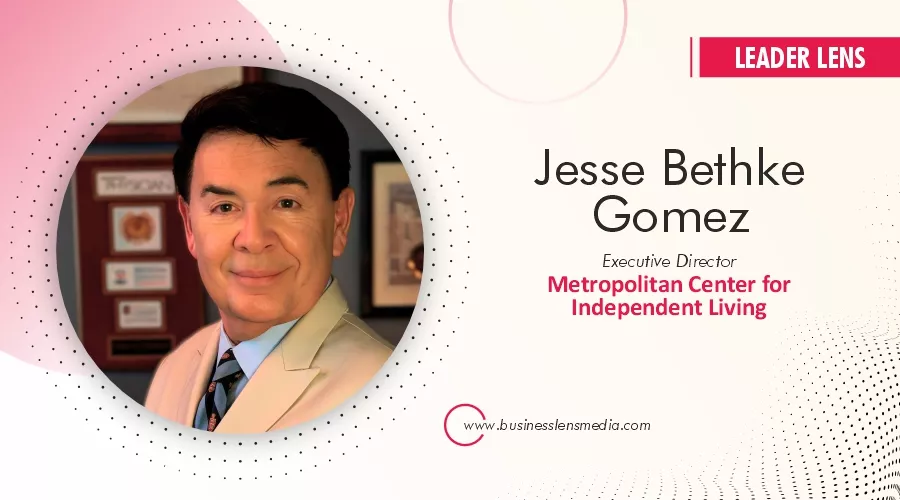
This philosophy is deeply reflected in the career of Jesse Bethke Gomez, Executive Director of the Metropolitan Center for Independent Living. Across decades of executive responsibility, his leadership journey has spanned corporate consulting, nonprofit enterprise development, and large-scale system design, shaped by global exposure and rigorous strategic thinking. His work reflects a belief that executive leadership is not merely a role, but a disciplined one that requires continuous learning, internal self-awareness, and an unwavering commitment to accountability.
What distinguishes his approach is not just operational command, but a rare ability to integrate strategic rigor with humanitarian purpose. Whether navigating governance structures, advancing workforce innovation, or addressing systemic barriers within care delivery, his leadership reflects a clear conviction: sustainable progress emerges when strategy is aligned with dignity, rights, and human potential.
Discover how this philosophy translates into action, influence, and lasting impact—read the full profile.
Foundations of Strategic Leadership
Early in his master’s degree education, Jesse Bethke Gomez recognized the importance of building depth across both executive leadership and strategic leadership. Rather than limiting his learning to theory, he intentionally sought applied exposure that would shape how he understood leadership at the highest levels. He successfully secured a world-renowned Director of Strategic Planning from a global Fortune 500 corporation to serve as faculty advisor for his master’s thesis in strategic planning. This real-world mentorship provided direct insight into how disciplined strategic planning functions as a guiding force for complex organizations and long-term corporate decision-making.
Upon completing his master’s degree, he was recruited to serve as a Senior Business Consultant with a management consulting firm, working with both local and international clients. Among them was a UNIX-based developer holding the number one tape backup system in the U.S. market, with operations spanning Bhopal, India; Germany; Silicon Valley; and headquarters in Minnesota. During this phase of his career, he had the rare opportunity to personally train with Dr. W. Edwards Deming, whose work helped rebuild Japan’s business sector after World War II and laid the foundation for the global quality improvement movement. Dr. Deming’s leadership philosophies left a lasting imprint on his approach to organizational excellence. As a consultant, he learned to identify the “drivers of success” unique to each industry and translate those insights into highly developed business and strategic plans for clients.
Transitioning Leadership Toward Service
As his consulting career progressed, Jesse Bethke Gomez realized the need to further deepen his executive capabilities while directing his leadership toward serving humanity. This realization led him to transition into the nonprofit and humanitarian sector, beginning with the American Red Cross. Selected through a national competition, he was awarded a Presidential Scholarship by then-President of the American Red Cross, Elizabeth M. Dole. Through this opportunity, he completed the Minnesota Executive Program for Advanced Strategic Leadership at the Curtis L. Carlson School of Management at the University of Minnesota. While the program was designed to prepare Fortune 500 executives to serve as CEOs, for him it became a vital bridge for applying corporate leadership discipline within nonprofit enterprise leadership.
He was subsequently recruited to serve as President of a major nonprofit organization, CLUES. Over a 17-year tenure, the organization expanded significantly and gained local, national, and international recognition for its work. Within its behavioral health services, the organization became a licensed clinic and conducted research that led to the development of coordinated care system designs. These models integrated behavioral health and primary healthcare within a person-centered, multi-payer delivery framework.
Reflecting on his leadership journey, he notes that over the past 25 years he has served sequentially as Chief Executive Officer for three corporations, advancing what he describes as “strategic optimization.” He emphasizes that executive leadership and strategic leadership are distinct yet equally essential disciplines, both required for sustained organizational effectiveness.
Leading an Enterprise in Practice
In his current role as Executive Director of the Metropolitan Center for Independent Living, Jesse Bethke Gomez often receives questions about what it truly means to lead an organization as a CEO. For him, leadership is as much about the journey of becoming a CEO as it is about showing up daily to lead the enterprise.
He consistently encourages aspiring executives to seek mentorship. Early in his career, he worked closely with Fortune 500 CEOs through United Way community fundraising initiatives, experiences that proved foundational to his executive development. One of his most influential mentors, a former Vice President of Human Resources for an international food company, imparted a principle that continues to guide his leadership: “You cannot delegate accountability as a CEO, but you can delegate responsibility.” Over time, he added a third dimension to this insight, understanding the wisdom required to distinguish between accountability and responsibility.
A CEO, he believes, must possess working knowledge across all functional areas of an organization. This includes accounting and fiscal policy, human resources and benefits administration, information technology, operations, services, products, marketing, communications, and legal and regulatory compliance. While an MBA may provide foundational understanding, executive development prepares leaders to steward entire enterprises. He consistently underscores the necessity of continuous professional development for those who aspire to executive leadership.
The Inner Work of Leadership
Beyond functional mastery, Jesse Bethke Gomez views self-awareness as essential to leadership effectiveness. Socio-emotional intelligence, reflection, and personal growth form the internal foundation for leading under pressure. A close colleague and friend, Tor Dahl, Chairman Emeritus of the World Confederation of Productivity Science, significantly influenced his thinking in this area. Jesse had the opportunity to assist Dahl in reviewing a keynote address delivered for China’s national productivity initiative, drawing on his experience working across 40 countries and 400 companies.
Dahl’s research confirmed that leadership grounded in socio-emotional intelligence directly impacts whether organizations achieve high performance. For Jesse Bethke Gomez, this insight reinforced the importance of leaders understanding their own comportment, emotional dynamics, and resilience under duress. He candidly acknowledges that serving as a CEO can be “soul-crushing,” making the internal journey of self-discovery and growth just as critical as external leadership skills. True enterprise leadership, he believes, requires both.
Navigating Complexity Through Multi-Disciplinary Thinking
Across his work in healthcare, public health, and governance, Jesse Bethke Gomez has collaborated with global thought leaders to address deeply complex societal challenges. Two guiding insights consistently shape his approach. The first is the principle of multi-disciplinarity, a framework he applied extensively while serving as Vice President of Planning and Development and Chief Strategy Officer for an urban university.
Complex societal issues rarely stem from a single cause. Understanding causation requires exploration across multiple fields, as no single discipline fully captures the convergence of factors involved. This multi-disciplinary lens informs MCIL’s work in addressing the humanitarian crisis caused by the direct care workforce shortage, an issue forcing individuals out of their homes, into institutional settings, intensive care units, or worse.
The second insight centers on understanding human social organization across time and cultures. Addressing healthcare efficacy and systemic design requires knowledge spanning sociology, psychology, economics, history, family systems, child development, aging, disability studies, democracy, language, culture, and international law. Societies function through shared laws, beliefs, customs, and systems, and meaningful reform depends on understanding how these elements interact.
Addressing Systemic Barriers in Independent Living
More than a decade ago, MCIL began witnessing growing human suffering caused by severe shortages in the direct care workforce. During the COVID-19 pandemic, this vulnerability intensified as individuals relying on federal and state services faced isolation due to longstanding asset limitations of $2,000 for individuals and $3,000 for couples. Since 2016, MCIL has worked toward scalable solutions to address this humanitarian crisis across Minnesota, the United States, and globally.
He emphasizes that the greatest challenge is not identifying solutions, but expanding awareness that creates action for the greater good and common good. People with disabilities live in every community and nation, and universal human rights life, freedom, happiness, and dignity are inherent to all. The humanitarian direct care crisis is global, and Jesse believes global action is required to solve the crisis.
How can action become a reality? Jesse identifies two fundamental verities essential for societies operating under constitutional governance that create the will of a people, a state or even a country to act.
The first is the responsibility of elected officials to address human suffering within constitutional frameworks. Constitutions exist to ensure societal continuity and protection of the public good across generations. The second verity is the enduring nature of individual rights under international law, treaties, and conventions. Governments may change, but the rule of law persists to safeguard humanity, dignity, peace, and prosperity.
When these two principles are honored, he observes, societies make their greatest progress. “It is not AI that solves these challenges,” he reflects. “Solutions emerge from the courage, commitment, and compassion of people to act for the greater good and common good.” Humanity, he believes, shares one race and one home, Earth.
Leadership Perspective Shaped by Global Exposure
His extensive board service and advisory roles at local, national, and international levels have refined his leadership philosophy. As his work expanded globally, he found that meaningful solutions often emerge at the most local levels. Research by Tor Dahl demonstrated that nations with the highest per capita incomes also exhibit the strongest levels of freedom, safety, and fairness.
He views the family, not government, as society’s primary social organizational unit, with governments playing a supporting role in strengthening family stability. At MCIL, this understanding led to the development of seven life-sustaining dimensions designed to stabilize families, individuals with disabilities, and older adults. Stabilized families, children and individuals foster social connectedness, which strengthens communities and supports sustainable economies always grounded in inalienable rights and human dignity.
Personal Meaning and Balance
Among his many recognitions, including being named among Minnesota’s Top 100 Most Influential Healthcare Leaders, Jesse Bethke Gomez finds the greatest fulfillment in work that advances humanity’s ability to care for one another and strengthens vibrant communities.
His commitment to balance stems from personal experience. As a teenager, he survived a serious bicycle accident that shaped his lifelong appreciation for life’s fragility. Guided by the belief reinforced by Dr. Deming that people are intrinsically motivated, he has consistently worked toward the greater and common good. His mother, Irene Gomez-Bethke, whom he describes as a historical figure in her own right, having served as the Commissioner of the Minnesota Human Rights Department, remains his enduring role model for compassion and service.
Beyond his professional life, he recently composed a full-length orchestral score titled “Mi Vida Amor,” registered with the Library of Congress. The Minnesota Orchestra has considered performing selections from the work, an experience he describes as deeply affirming. For him, life is about balance, honoring purpose, creativity, and joy every day.
Advancing the Future of Direct Care
Looking ahead, Jesse Bethke Gomez remains focused on transforming the homecare sector within healthcare systems worldwide. MCIL is advancing a college credit–based curriculum leading to the credential of “Certified Direct Support Professional,” a voluntary and advanced career pathway designed to strengthen the direct care workforce. The credential can be earned independently or alongside a bachelor’s degree, with legislative emphasis on competitive compensation.
He highlights the urgency of addressing outdated asset limitations and expanding educational pathways for the more than five million direct care workers in the United States alone. Unlike the medical sector, which has long offered credit-based certification for nursing assistants, the homecare sector has lacked comparable advancement opportunities until now.
This globally scalable solution has received critical support, including a $2.1 million grant from the Bush Foundation. MCIL views this initiative as transformative in advancing the shared human responsibility to care for one another.