In periods of transformative change, leaders reveal their true character. Decisions sharpen, relationships are tested, and leadership moves from theory to consequence. It is at these inflection points when certainty is scarce and stakes are high that meaningful progress is either forged or forfeited.
The leaders who endure are not merely those with authority, but those with the clarity and conviction to act, the humility to listen, and the resilience to learn forward. This profile explores a career shaped by such moments, where transformation is not an abstract ambition, but a lived responsibility.
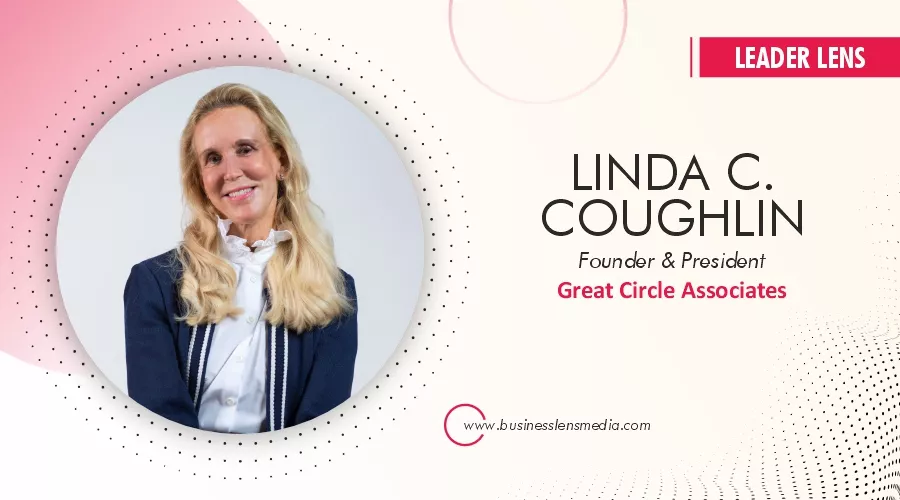
At the center of this narrative stands Linda (Lin) C. Coughlin, Founder & President of Great Circle Associates, whose professional journey reflects a deep understanding of how people and enterprises evolve under pressure. Long before stepping into an advisory role, she operated inside complex organization systems where growth demanded difficult choices and human trust was as critical as strategy.
That experience continues to inform her distinctive perspective, one grounded in disciplined thinking, emotional intelligence, and an unwavering commitment to helping leaders rise when circumstances demand more of them than comfort allows.
Rather than offering answers from a distance, her work is marked by proximity: to the realities leaders face, the doubts they rarely voice, and the consequences their decisions carry beyond quarterly results. She engages at the intersection of performance and humanity, guiding individuals and organizations through change that reshapes not only structures, but mindsets and cultures. In doing so, she has built enduring relationships defined by trust, candor, and shared accountability.
Step into her story which is less about titles and more about the impact of leadership, when practiced with intention, can become a catalyst for lasting change.
A Career Forged in Transformational Leadership
Coughlin’s journey toward founding Great Circle Associates was not sparked by theory or aspiration alone; it was forged through nearly two decades of hands-on leadership in some of the most demanding environments corporate America has to offer. Before stepping into entrepreneurship, she spent over 15 years in senior operating roles, leading organizations through moments that defined their future: Post-Merger Integrations, Rightsizing Initiatives, Corporate Turnarounds, Internal Start-Ups, New Market Entries, and Large-Scale Rebranding Efforts.
These were not incremental adjustments. They were enterprise-level transformations that tested leadership resolve, organizational trust, and strategic clarity. Throughout this period, Coughlin became deeply intentional about the people she surrounded herself with.
She sought leaders who were not only intelligent and capable, but emotionally attuned, deeply motivated, and willing to challenge conventional thinking. Many of them, by her own admission, had the potential to ‘do circles around’ her and she considered that a strength, not a threat.
She invested heavily in their development, both individually and collectively, committing a significant portion of her time to coaching and mentoring high-potential leaders. The return on that investment proved extraordinary. She built leadership teams willing to push beyond comfort, confront complexity head-on, and commit to change not as a short-term mandate, but as an enduring, game-changing imperative.
Given this foundation, the transition into executive coaching and advisory work nearly twenty years ago felt natural rather than disruptive. As Founder and President of Great Circle Associates, Coughlin stepped into a role that allowed her to amplify the work she found most meaningful, guiding leaders through transformation with clarity, humanity, and rigor.
She often reflects on that decision with quiet certainty: “Once a client, always a friend.” It is a sentiment that captures both her relational approach and the depth of trust she builds with those she advises.
Guiding Leaders at Critical Inflection Points
Coughlin’s work places her alongside leaders navigating some of the most consequential moments of their careers, periods where strategic decisions carry lasting organizational and personal implications. Her approach begins with disciplined immersion. She invests deeply in understanding each client’s business model, drawing on her own operating experience, strategic planning expertise, and communications acumen to quickly grasp both visible priorities and underlying tensions.
One of her earliest interventions often focuses on an invisible yet pervasive barrier: Imposter Syndrome. Research suggests that nearly 70% of leaders experience it at some point, and Coughlin has seen firsthand how profoundly it can limit growth, particularly in organizations that require bold vision and decisive execution.
To address this, she guides leaders through a structured nine-step process designed to dismantle imposterism at its roots. These are:
- Recognition:
She believes awareness is the first catalyst for change. Leaders are encouraged to remember their origins, reflect on the discipline and resolve that shaped their journey, and reconnect with the strengths they have spent years cultivating.
- Shared Reality:
Realizing that they are not alone is equally important. Even highly visible executives grapple with doubt. Coughlin often references Howard Schultz’s candid admission during his tenure at Starbucks, when he acknowledged feeling undeserving and insecure. As Schultz once shared with The New York Times, “Very few people… get into the seat and believe that today they are qualified to be a CEO. They’re not going to tell you that, but it’s true.”
- Open Dialogue:
Speaking openly with trusted colleagues helps leaders reframe moments of self-doubt rather than internalizing them. Coughlin emphasizes that these conversations often reveal shared experiences, reducing isolation and restoring perspective.
- Real-Time Fear Interruption:
Leaders are then encouraged to confront fear in real time accepting that doubt may never fully disappear, but learning to interrupt its narrative. This requires deep self-awareness and intentional reframing. As she often advises, “If I’m going to doubt something, I’m going to doubt my limits.”
- Servant Leadership Orientation:
It plays a central role in this transformation. By shifting attention from self-evaluation to contribution, leaders move from fear-driven perfectionism toward purpose-driven impact. The internal question evolves from “Am I good enough?” to “How can I help?” a far more sustainable foundation for leadership.
- Bold, Achievable Goal Setting:
Setting bold yet attainable goals & then celebrating the accomplishment of each goal work as motivation to keep going.
- Outcome Visualization:
Whether it’s completing a task or pitching a challenging departure from the status quo, imagine the change you want to see. It will help to maintain focus and calm.
- Failure Reframed as Learning:
Reimagine failure as a learning opportunity. Be open to and embrace lessons learned and act on them.
- Mindset Reorientation:
The last step to stop feeling like an imposter is to stop thinking like one. Instead of telling yourself that you are going to be found out or that you don’t deserve success, be aware that it’s normal not to know everything. Setbacks happen to everyone. Honor your vulnerability and have faith that you will learn as you go, as you always have.
According to Coughlin, leaders who move through this process often discover that confidence is not the absence of doubt, but the ability to act decisively in its presence.
How Operating Experience Shapes Advisory Philosophy
Decades of leading high-stakes initiatives have profoundly shaped Coughlin’s leadership philosophy, moving it beyond conceptual frameworks into lived wisdom. Her experience across mergers, acquisitions, IPOs, turnarounds, market expansions, and rebranding efforts has instilled a set of enduring convictions.
At the core is a preference for clarity over complexity. As Coughlin often puts it, “Strategy is not a presentation; it’s a series of choices made under pressure, where clarity, ownership, and pace matter just as much as insight.” Execution quality matters as much as strategic brilliance, if not more. Simplicity, alignment, and disciplined pacing consistently outperform cleverness.
Repeated exposure to disruption has also shifted her perspective from control to stewardship. Sustainable change cannot be forced. It emerges when leaders mobilize people around shared intent, empower capable teams, and create environments where trust and accountability coexist.
Perhaps most significantly, Coughlin has moved from valuing individual brilliance to championing collective intelligence. Complex transformations expose the limits of any single leader. High-impact teams rooted in trust, shared accountability, transparency, and constructive dissent consistently outperform hierarchical expertise, particularly when data is incomplete and stakes are high.
Her operating experience has also reinforced a long-term view of enterprise health. Short-term wins achieved at the expense of culture, talent, or credibility invariably exact a cost. Over time, her philosophy has evolved into one that integrates financial performance with organizational wellbeing and brand integrity.
Finally, sustained exposure to ambiguity has cultivated humility. Comfort with uncertainty, emotional steadiness, and resilience have become non-negotiable leadership traits. As she models with clients, the ability to say “I don’t know yet” often strengthens credibility rather than diminishing it.
Together, these shifts shape how Coughlin shows up with clients today not as a distant advisor, but as a thought partner who understands both the weight of leadership decisions and the realities of carrying them forward inside complex systems.
Staying Ahead Across Diverse Industries
Working across sectors ranging from asset management to healthcare technology demands more than surface-level awareness. For Coughlin, staying ahead of industry dynamics requires disciplined curiosity, pattern recognition, and close proximity to real work.
Rather than pursuing deep specialization in every domain, she has focused on becoming what she describes as an ‘exceptional translator of change.’ She tracks recurring forces, regulation, digitization, talent scarcity, margin pressure, AI adoption and studies how they manifest differently across industries. This allows her to help clients anticipate second- and third-order implications before competitors recognize them.
Equally important is her commitment to staying close to operators. Conversations with leaders managing P&Ls, integrating acquisitions, or modernizing platforms often reveal emerging realities long before they surface in reports or conferences.
Coughlin is intentional about filtering signals from noise. She curates a focused set of high-quality inputs, trusted analysts, earnings calls and regulatory updates, balancing them with periodic deep dives. The objective is synthesis, not saturation.
By pressure-testing insights across industries and embedding adaptive foresight into client engagements, she helps leaders scenario-test strategies against multiple futures. In doing so, she positions herself not as an episodic advisor, but as a steady partner in navigation.
Leadership Qualities for High-Stakes Environments
Coughlin believes the next generation of C-suite leaders will be defined less by technical mastery and more by their ability to integrate logic with humanity and performance with purpose. In environments shaped by volatility, complexity, and societal change, five leadership qualities stand apart.
Human-centric systems thinking reframes organizations as living ecosystems rather than machines. Foresight and future literacy enable leaders to anticipate multiple trajectories rather than betting on a single outcome. Digital and AI fluency, guided by ethical stewardship, ensures technology serves strategy not the reverse.
Narrative power has become equally critical. Leaders today are meaning-makers, responsible for aligning people through uncertainty with authenticity and trust. Finally, regenerative leadership recognizes sustainability not as an initiative, but as a core responsibility that links long-term resilience to planetary and societal health.
These qualities are not theoretical ideals in her work; they form the backbone of how she helps leaders expand their capacity to lead responsibly, decisively, and sustainably in high-stakes environments.
Recurring Challenges in Transformation
Across continents and industries, Coughlin observes a consistent pattern in transformation efforts. Failures rarely stem from flawed strategy alone. More often, they arise from unclear narratives, misalignment between strategy and execution, cultural inertia, leadership capability gaps, insufficient psychological safety, and chronic change fatigue.
Perhaps most underestimated is the human cost of transformation. When leaders overlook the emotional and relational impact of change, trust erodes and discretionary effort declines. Successful transformations, she notes, pair strategic clarity with cultural intention treating trust, learning, and alignment as essential enablers.
Organizations that succeed through transformation are those that treat alignment, trust, and learning not as secondary considerations, but as core operating disciplines.
Sustaining Balance and Personal Renewal
Despite a demanding portfolio of advisory, coaching, and board responsibilities, Coughlin is intentional about renewal. She protects time for reflection through writing and teaching spaces where insight crystallizes into perspective.
Outside work, she finds joy and discipline in competitive ballroom dancing and cherishes time with her twelve grandchildren. These pursuits ground her, offering both creative expression and personal connection.
She views renewal not as time away from leadership, but as an essential input into sound judgment, emotional regulation, and long-term effectiveness.
A Vision for the Future
With more than four decades of leadership experience, Coughlin views her journey as actively unfolding. Through Great Circle Associates, she continues to expand her impact particularly in eliminating imposter syndrome, advancing women leaders, fostering intergenerational dialogue, and challenging outdated models of power.
Her vision of leadership is deeply human. She envisions a world where influence is measured not by hierarchy or volume, but by impact where leaders are remembered for the relationships they nurtured and the courage they inspired. As she reflects, she hopes her legacy will be that of someone who helped restore leadership to its rightful place: “a calling, not a crown.”
In particular, she is focused on reshaping how power is exercised in leadership systems, moving away from dominance-based models toward approaches grounded in partnership, trust, and shared accountability.
Guidance for Emerging Leaders
Drawing from nearly two decades of advising change-makers, Coughlin is candid about the reality of transformation: only about 30% of change efforts succeed. The most common pitfall is impatience skipping steps in pursuit of speed.
She emphasizes that meaningful change unfolds in phases, each requiring discipline and care. From establishing a sense of urgency to building coalitions of passionate champions to embedding new behaviors into culture, every step matters. Mistakes made early often reverberate long after momentum appears strong.
Through lived experience including a challenging post-acquisition integration that ultimately transformed two organizations Coughlin underscores the power of relationship-building, active listening, accountability over time, and courageous humility.
For leaders committed to driving Change at Core™, her guidance is clear: be bold; be patient, lead from your heart, then yourhead; and never underestimate the power of trust.