Leadership at pivotal moments rarely announces itself with noise. It shows up quietly, in the discipline to ask harder questions when everyone else is racing ahead. In today’s enterprise landscape, artificial intelligence has moved from experimentation to expectation. Yet the real transformation is not technical. It is structural. It is cultural. And above all, it is operational.
The shift unfolding inside modern organizations is subtle but profound. AI is no longer just a tool assisting individuals. It is becoming an active participant in workflows, decision-making, and execution. The movement from helper to teammate, from copilot to agent, demands not only innovation but governance, clarity, and intentional design.
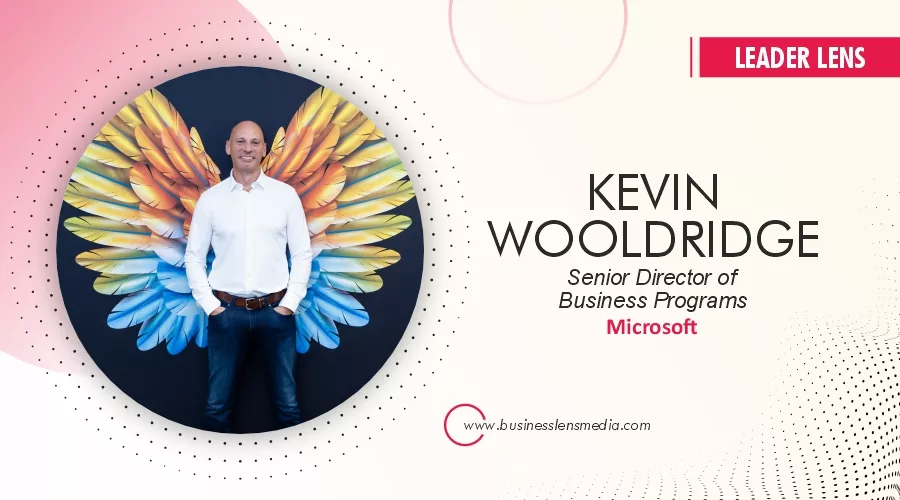
It is within this context that Kevin Wooldridge, Senior Director of Business Programs at Microsoft, has emerged as a steady architectural voice. His work sits at the intersection of enterprise strategy, operational transformation, and responsible innovation. Rather than chasing novelty, he focuses on operationalizing intelligence at scale ensuring that experimentation matures into disciplined execution.
The result is leadership that blends empowerment with accountability, and vision with delivery.
Step inside the thinking shaping one of the most significant AI transformations inside a global enterprise.
From Copilot to Colleague
The language around AI has evolved quickly. Early narratives centered on assistance drafting emails, summarizing documents, generating code. Helpful, yes. Transformational, not quite.
Kevin’s perspective sharpened during Microsoft’s Customer Zero journey, where internal teams became the proving ground for Microsoft 365 Copilot and emerging agentic systems. What began as deployment quickly evolved into something deeper: a move toward enabling employees to build, govern, and operationalize identity-bound, auditable AI agents capable of executing real workflows end-to-end.
Inside Microsoft Digital, this transition marked a decisive inflection point.
AI was no longer an augmentation experiment. It was production infrastructure.
Yet Kevin understood early that empowerment without governance risks chaos. Citizen development at scale, if left unstructured, generates innovation without coherence. The breakthrough insight from Customer Zero was not simply that agents could work — it was that innovation must scale responsibly.
Low-code creation through Copilot Studio was paired deliberately with centralized oversight, observability, and measurable outcomes. Experimentation remained encouraged, but within defined guardrails.
For Kevin, this balance is not bureaucratic friction. It is maturity.
Outcomes Over Noise
One of the quiet failures of digital transformation has often been overactivity without impact. Tools proliferate. Dashboards multiply. Metrics expand. Yet measurable business outcomes remain elusive.
Kevin resists this pattern.
Customer Zero immersion programs revealed that structured usage expectations, habit-forming prompts, and aligned business scenarios directly correlated with revenue lift and accelerated deal cycles. AI delivered value not when it was impressive, but when it was purposeful.
This reinforced a hard-earned truth: technology alone does not change performance. Behavior does.
AI initiatives that fail to incorporate change management, usage discipline, and structured operating rhythms generate excitement without return. Those that embed accountability generate measurable progress.
In Kevin’s framing, transformation is less about deploying models and more about shaping habits.
Bridging Empowerment and Enterprise Discipline
Kevin thrives in environments where ambiguity is high and stakes are visible. His broader remit as Senior Director of Business Programs has long required aligning senior leaders around clear priorities, converting complexity into actionable program portfolios, and institutionalizing governance that strengthens capability rather than constraining it.
That discipline carries directly into AI strategy.
As conversations across Microsoft expand from Darren Hardman’s emphasis on national-scale skilling to Pam Maynard’s identification of the “capacity gap,” and Judson Althoff’s frontier architecture vision Kevin focuses on something connective: operational reality.
If agents are to own HR workflows, finance approvals, or frontline support, organizations must move beyond pilot enthusiasm. They must treat AI assets as portfolios, complete with identity, telemetry, lifecycle management, and service-level accountability.
This shift reframes agents not as experiments, but as enterprise assets.
From productivity to process.
From processes to portfolios.
From portfolios to platforms.
The progression is neither inevitable nor automatic. It requires leaders capable of blending empowerment with enterprise guardrails — freedom with structure.
The Governance Imperative
As AI agents expand influence across sensitive domains HR, legal, regulated industries governance becomes less optional and more existential.
Kevin’s experience in shaping enterprise transformation reinforces a simple conviction: unmanaged complexity erodes trust.
Observable systems. Clear oversight. Defined lifecycle management. Repeatable blueprints.
These are not administrative afterthoughts. They are prerequisites for scale.
Microsoft’s internal experience illustrates this vividly. GitHub Copilot contributing significantly to engineering productivity is not just a technical success; it is a governance success. Agents operating within HR and IT are not merely capabilities; they are controlled environments aligned to policy.
Leadership in this space means ensuring that innovation does not outrun responsibility.
Capacity, Not Replacement
Perhaps the most important reframing emerging from this era is human-centered.
AI agents are often discussed in terms of efficiency. Kevin aligns more closely with the capacity argument. Workers today operate under continuous interruption, cognitive overload, and task fragmentation. If agentic AI does not return meaningful capacity to people time for deeper work, strategic thinking, and creativity it fails the larger purpose.
Automation without elevation is hollow.
Agentic systems must reduce noise, not amplify it.
In Kevin’s view, the operating system for modern work is not defined by automation alone. It is defined by structured augmentation where empowerment meets accountability and measurable business impact aligns with human experience.
Discipline in High-Stakes Environments
Kevin’s career has consistently unfolded in high-stakes, ambiguous environments. Whether shaping transformation portfolios or enabling AI ecosystems, the throughline remains consistent: clarity in complexity.
He establishes governance frameworks that invite contribution while enforcing standards. He aligns stakeholders across competing priorities. He ensures strategic ambition translates into operational discipline.
This blend of strategic insight and grounded execution is what enables innovation to move beyond aspiration.
Beyond the Enterprise: A Wider Responsibility
Outside his corporate leadership, Kevin’s commitments reflect a broader philosophy of stewardship. Through support of Access Sport, involvement in the MOJOE initiative, and leadership within Fair Game, he invests in ethical, community-led governance in sport.
The thread connecting these engagements to his enterprise work is not accidental. Both require aligning stakeholders, balancing empowerment with accountability, and building systems that outlast individual tenures.
For Kevin, leadership is not situational. It is structural.
Defining the Next Horizon
Looking forward, three horizons are already forming.
Agents managing discrete productivity tasks.
Agents owning end-to-end business processes.
Agent portfolios integrated into foundational enterprise platforms.
The shift is not simply technological; it is architectural.
Kevin’s perspective remains clear: agentic AI is becoming the operating layer for modern enterprises. But architecture alone will not define success. Stewardship will.
When empowerment is matched with governance.
When innovation is disciplined by outcomes.
When AI is designed intentionally rather than reactively.
That is when transformation becomes durable.
And in durable change not flashy experimentation Kevin Wooldridge continues to shape the future of enterprise work.