Lasting leadership is rarely forged in comfort. It is shaped in close view of the barriers that quietly determine who advances and who remains excluded. When systems repeatedly fail certain communities, the issue is seldom individual potential; it is structural design. True change, therefore, demands more than support. It requires reconstruction.
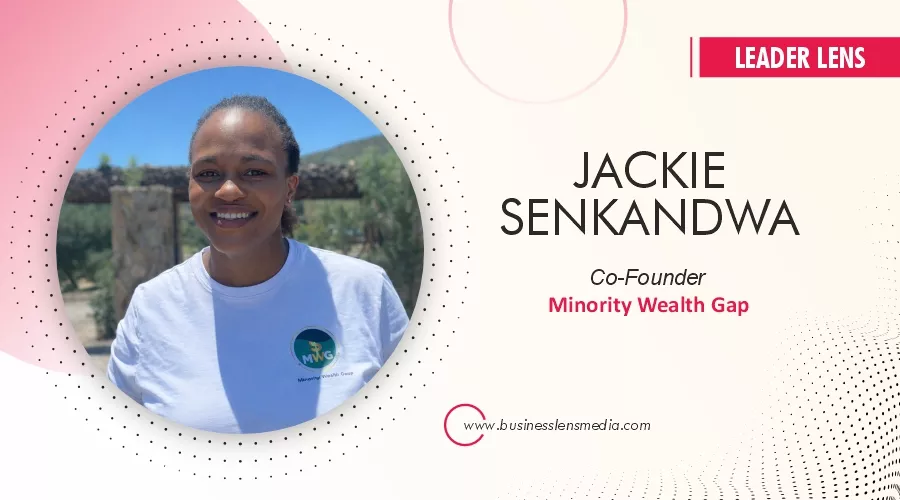
It was within this reality that Jackie Senkandwa, Co-Founder of Minority Wealth Gap, began redefining what economic empowerment could mean in Los Angeles, California. Rather than addressing surface-level symptoms, she turned her focus toward the foundations of opportunity itself. Her work operates at the intersection of ownership, access and long-term mobility, challenging the notion that employment alone secures stability. By shifting the emphasis from participation in the economy to influence within it, she has positioned enterprise as a tool for restoring agency and reshaping generational outcomes.
Under her leadership, Minority Wealth Gap advances a model rooted in infrastructure building, connecting capital, training, mentorship and culturally grounded enterprise into cohesive ecosystems. From initiatives that support returning citizens to youth-focused entrepreneurship programs, her approach recognizes that dignity and prosperity are sustained when communities are equipped not just to earn, but to build and retain wealth. It is a philosophy that treats culture as an economic asset and ownership as a pathway to lasting autonomy.
In an era where equity conversations often remain theoretical, Jackie’s work offers a practical blueprint for systemic change, one designed for replication, resilience and shared prosperity.
Discover how her vision is transforming economic possibilities across communities.
Proximity as a Catalyst for Leadership
Jackie Senkandwa’s leadership did not emerge from theory or boardrooms. It emerged from proximity from standing close enough to see the gaps that systems leave behind.
Her early work supporting women escaping domestic violence and individuals reentering society after incarceration exposed a recurring pattern. The challenge was not a lack of resilience, intelligence, or ambition. It was the absence of access. Access to capital. Access to networks. Access to stable pathways that could translate effort into mobility.
Over time, Jackie recognized something fundamental: economic instability is rarely accidental. It is often structured. Families trapped in cycles of hardship are not simply navigating poor choices; they are navigating systems that were not designed with them in mind.
That realization reframed her understanding of entrepreneurship. “Business ownership is not just about income it is about influence and access,” she says. Ownership changes negotiation power. It stabilizes households. It expands decision-making capacity. It allows families to plan rather than react.
This shift marked a turning point. Jackie’s leadership philosophy evolved from supporting individuals within existing systems to redesigning the economic pathways themselves. Enterprise, in her view, became not just a business model but a mechanism for liberation.
Minority Wealth Gap: Engineering Economic Infrastructure
As Co-Founder of Minority Wealth Gap, Jackie operates with a systems mindset. The organization was founded to address structural disparities in generational wealth, particularly within racialized and underserved communities across the USA.
From the outset, Minority Wealth Gap was not designed as a traditional nonprofit focused solely on service delivery. Its mission centers on economic infrastructure building the pipelines that allow individuals to move from workforce participation to ownership.
Jackie often describes her role as that of a bridge. She connects capital to community. She connects opportunity to preparation. She connects ambition to structured pathways.
Economic equity, she emphasizes, requires more than good intentions. It requires workforce training aligned with emerging industries, comprehensive financial literacy, access to markets, capital readiness, and cross-sector partnerships. It requires mentorship models that do not end after a workshop. It requires systems that allow individuals to accumulate, protect, and grow assets.
Rather than creating isolated programs, Minority Wealth Gap develops interconnected ecosystems. Technology pathways are paired with digital literacy. Cosmetology programs are paired with business ownership planning. Entrepreneurship training is paired with capital access strategies.
The objective is not temporary employment. It is long-term economic mobility.
The Cultural-Economic Intersection
One of Jackie’s most distinctive leadership strengths lies in her understanding of culture as capital.
Many economic development initiatives treat culture as an accessory useful for branding but irrelevant to infrastructure. Jackie rejects that framing. She recognizes that culture shapes consumer behavior, brand trust, and community loyalty. It is not peripheral to commerce; it is central.
“Culture is not separate from commerce, it is an asset,” she explains.
This belief informs how Minority Wealth Gap designs initiatives. When economic models are culturally rooted, they gain legitimacy. When they celebrate identity rather than suppress it, participation increases. When communities see themselves reflected in enterprise, ownership becomes aspirational rather than distant.
This cultural-economic insight became the foundation for one of the organization’s most ambitious initiatives: Africana Star.
Africana Star: Designing a Social Economic Enterprise
The Africana Star was born from observation. Through direct engagement in correctional facilities and reentry programs, conducted in partnership with the Financial Literacy Training Academy (FLTA), Jackie and her team saw the consequences of systemic exclusion firsthand.
Individuals returning home from incarceration often reenter society with limited job prospects, damaged credit histories, and minimal access to entrepreneurship support. Despite resilience and desire to contribute positively, structural barriers prevent stable reentry.
Africana Star was created as a response not as charity, but as enterprise.
Structured as a for-profit Social Economic Enterprise, Africana Star blends revenue generation with workforce development and cultural affirmation. Its sectors were selected deliberately: African-inspired fashion and clothing, alongside hair and beauty services.
These industries offer accessibility, scalability, and cultural resonance.
The fashion division supports African-owned designers and creatives, providing platforms to showcase and sell their work both locally and online. Through its e-commerce presence, Africana Star amplifies global African narratives while generating income for underrepresented designers.
Simultaneously, the hair and beauty services division provides structured employment for individuals reentering society. Participants receive hands-on industry training, customer engagement experience, digital marketing exposure, and operational knowledge.
The roles are designed for sustainability. Participants gain transferable skills and professional confidence. Income becomes a stabilizing force rather than a temporary patch.
What differentiates Africana Star is its refusal to treat employment and entrepreneurship as separate tracks. Workers are encouraged to envision themselves as future business owners. Enterprise becomes a training ground for ownership.
This dual pathway employment today, ownership tomorrow aligns directly with Minority Wealth Gap’s broader mission of generational wealth creation.
Youth as a Strategic Priority
Economic empowerment cannot begin at adulthood alone. Recognizing this, Jackie and her team expanded Africana Star’s model to include youth intervention.
In collaboration with FLTA, Minority Wealth Gap is preparing to launch a 15-week, year-round youth entrepreneurship camp built around a proven 10-step business framework. The curriculum simplifies business development into accessible stages, covering credit building, budgeting, cash flow management, branding, digital marketing, and entrepreneurship fundamentals.
Over the past three years, this structured program has helped more than 50 youth launch businesses.
However, Jackie views business ownership as only part of the impact. The deeper transformation lies in mindset. The youth initiative prioritizes confidence, leadership development, and decision-making skills. Participants begin to see themselves as economic contributors rather than future liabilities.
By intervening early, the organization seeks to disrupt cycles that often lead young people toward economic marginalization or criminal justice involvement. Prevention and intervention operate within a single ecosystem.
Leading Through Structural Resistance
Addressing generational wealth disparities requires navigating systems that were never built for equitable participation.
Jackie has encountered the realities of funding inequities, institutional gatekeeping, and policy environments that require both persistence and strategic negotiation. She understands that sustainable impact demands diplomacy as much as conviction.
Another ongoing challenge is balancing urgency with durability. Communities require immediate solutions. Yet building infrastructure requires patience and discipline.
Recognition has followed her work, but she interprets visibility as responsibility. “Awards are not endpoints, they are reminders that others are watching and learning,” she says.
For Jackie, leadership is stewardship. Success must widen access rather than concentrate influence.
Defining Impact Beyond Revenue
Financial growth is necessary for sustainability, but Jackie measures success through broader indicators as given below:
- Are participants building assets?
- Are families achieving housing stability?
- Are entrepreneurs reinvesting profits within their communities?
Minority Wealth Gap tracks mentorship retention rates, job placements, business launches, and long-term engagement. These metrics reveal whether systems are producing stability or merely temporary relief.
Impact, in her framework, is visible when individuals transition from surviving to planning.
Sustaining Leadership Through Alignment
Leading a growing organization while maintaining personal clarity requires discipline. Jackie emphasizes structured time management and strategic delegation. She invests in advisors who provide both challenge and perspective.
Spiritual grounding and family alignment serve as stabilizing forces. “Balance is not perfection, it is alignment,” she reflects.
When her work reflects her values, energy becomes renewable rather than depleted.
A Vision for 2026 and Beyond
Looking toward 2026, Jackie envisions Africana Star evolving into a nationally scalable employment ecosystem. The goal is to create stable economic pathways for returning citizens, vulnerable youth, and aspiring entrepreneurs.
Employment remains one of the strongest predictors of successful reentry and reduced recidivism. By embedding dignity within economic opportunity, Africana Star addresses the root causes of instability.
Minority Wealth Gap also plans to expand capital access funds, strengthen cross-sector partnerships, and replicate its ecosystem model in additional regions.
The objective is not isolated success stories. It is structural change that can be reproduced.
An Invitation to Shared Prosperity
For global business leaders seeking to build purpose-driven organizations, Jackie offers a concise blueprint:
“Start with clarity of mission, then build systems that support it. Purpose without structure leads to burnout. Structure without purpose leads to stagnation.”
Her advice emphasizes partnership, accountability, and outcome measurement. Enterprises must be designed to generate shared prosperity, not just shareholder returns.
Africana Star stands as proof of what becomes possible when commerce, culture, and community align. It is not merely a brand. It is a declaration that ownership, dignity, and opportunity can coexist within scalable enterprise.
As Minority Wealth Gap moves into its next chapter, Jackie invites collaborators, ecosystem partners, and funders to participate in expanding this work. The mission remains clear: to close generational wealth gaps by building the infrastructure of ownership one enterprise, one pathway, and one community at a time.
If you would like to support Minority Wealth Gap’s mission, contributions can be made at:
https://avvmtgju.donorsupport.co/page/FUNSHHMBTQJ