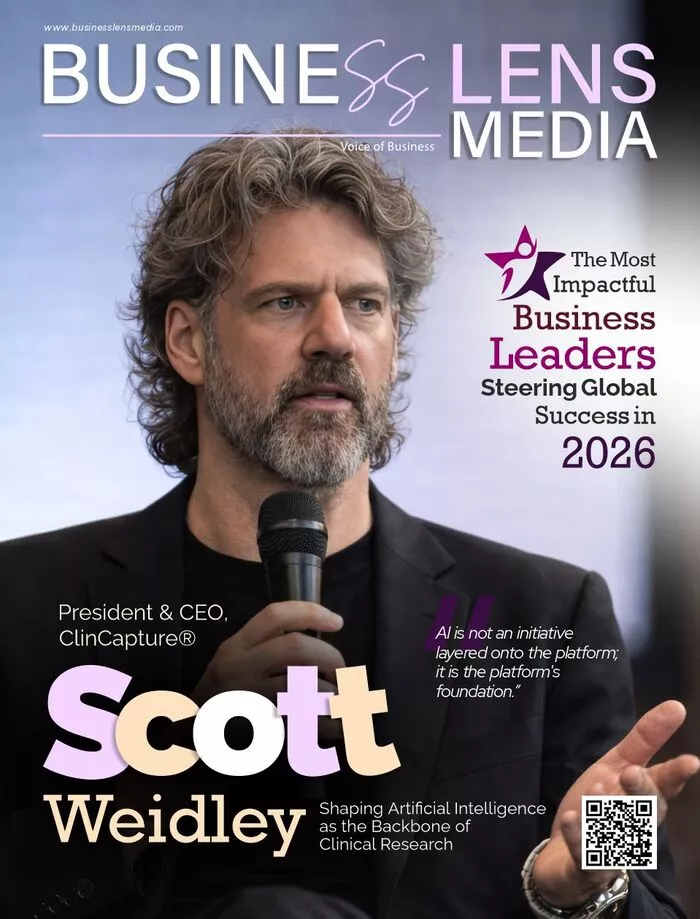
“Progress in clinical research rarely announces itself with disruption alone,”
– Scott Weidley
More often, it arrives through leaders who recognize what is inevitable long before it becomes obvious, and who quietly prepare systems to meet that future with discipline and intent. In an industry defined by precision, regulation, and accountability, meaningful advancement depends on the ability to anticipate change without compromising trust. The most influential voices are those who understand that innovation must be engineered thoughtfully, built to endure scrutiny, and designed to serve both science and people.
It is within this context that Scott Weidley, President & CEO of ClinCapture®, has emerged as a steady architect of forward-looking clinical technology. His leadership reflects a deep understanding of how intelligence can be embedded into complex systems without becoming intrusive or unreliable. Rather than pursuing novelty for its own sake, his approach centers on building platforms that are prepared for what lies ahead, capable of evolving alongside advances in automation, analytics, and human decision-making. The result is a leadership style grounded in foresight, execution, and respect for the realities of regulated environments.
As the industry moves toward more complex, decentralized, and data-intensive trials, the need for clarity becomes paramount. The challenge is no longer whether technology can advance, but whether it can do so responsibly, transparently, and at scale. Leaders who can balance speed with rigor, and ambition with accountability, are the ones shaping the next phase of global clinical research.
Read this profile to explore how Weidley’s long-term vision, system-level thinking, and execution-focused leadership are influencing the way intelligence is integrated into clinical trials.
Architecting the Future of Intelligence-Driven Clinical Trials
Scott Weidley’s leadership philosophy has been shaped by a long-held conviction that clinical trials would eventually move beyond being systems of record and evolve into systems of intelligence. Over more than 15 years in the eClinical SaaS space, this belief steadily guided his decisions. Still, it crystallized fully in 2015 after he read “The AI Revolution: The Road to Superintelligence” by Tim Urban. What resonated was not speculative futurism, but the idea of inevitability, the understanding that artificial intelligence rarely arrives as a single disruptive moment. Instead, it embeds itself quietly into systems already capable of absorbing its influence.
From that realization onward, Weidley made a conscious choice to architect software for where the industry was headed, not where it currently stood. Rather than focusing narrowly on optimizing existing workflows, he led the development of a platform designed to accommodate machine-assisted reasoning, advanced signal detection, and adaptive oversight as AI capabilities matured. For him, leadership meant positioning the organization several steps ahead of where industry conversations would eventually converge.
Making AI the Organizing Principle, Not an Add-On
In his role as President and CEO of ClinCapture®, Weidley balances strategic leadership with hands-on oversight of product development and customer delivery by anchoring everything to a single principle:
“AI is not an initiative layered onto the platform; it is the platform’s foundation.”
Captivate, the software used by ClinCapture® for all Electronic Data Capture (EDC) purposes, was intentionally designed as an AI-ready clinical operating system, built on structured data models, configurable workflows, and rigorous validation frameworks that allow intelligence to be deployed safely within regulated environments.
From a strategic standpoint, his focus is on identifying where intelligence creates the greatest leverage, whether through automated data review, early risk identification, adaptive monitoring, or operational forecasting. At the same time, he remains closely engaged with product and delivery teams to ensure these capabilities are not abstract concepts, but practical tools actively improving how trials are designed, monitored, and completed. As he sees it, vision without execution has little power to move an industry forward.
Staying Ahead in a Regulated and Rapidly Shifting Landscape
Weidley believes, “Sustained relevance in clinical trials technology depends on anticipating regulatory and operational expectations before they fully take shape.” ClinCapture’s AI strategy was defined years before formal guidance began to solidify, guided by principles, transparency, explainability, auditability, and clear human accountability that now closely align with emerging expectations from the U.S. Food and Drug Administration.
Rather than relying on opaque, black-box models, the company has focused on intelligence that surfaces meaningful signals, prioritizes attention, and supports informed decision-making while keeping responsibility firmly with sponsors and investigators. This approach allows ClinCapture® to innovate with confidence while remaining regulator-ready. The result is technology that earns trust from regulators and delivers reliability for operators working under real-world pressures.
Scaling Speed Without Sacrificing Rigor
One of the most demanding leadership challenges Weidley has faced is scaling innovation at speed without compromising rigor. Biotech and molecular diagnostics organizations require agility and rapid execution, yet the integrity of their data must withstand intense scrutiny. Introducing advanced automation and analytics at scale requires more than technical sophistication; it demands strong governance, disciplined change management, and careful alignment with customer expectations.
For Weidley, leadership in this space is about setting the right guardrails. These structures are not meant to slow innovation, but to ensure that acceleration strengthens trial execution rather than destabilizing it. When done well, rigor becomes an enabler of speed, not an obstacle to it.
Building Innovation That Delivers Measurable Impact
Innovation within ClinCapture® is encouraged through a clear connection to outcomes that matter. Teams are challenged to focus on tangible improvement,s fewer queries, faster study builds, cleaner datasets, and earlier detection of risk. A consistent question guides development efforts: where are humans performing repetitive work that machines can reliably assist with, and where could better signals prevent downstream issues before they escalate?
Collaboration across product, quality, delivery, and regulatory functions ensures that innovation remains grounded in operational reality. Accountability is reinforced by tying every new capability to measurable improvements in performance and quality results that customers can see, validate, and trust.
Thinking in Systems, Not Features
Weidley stays ahead of technological, regulatory, and market shifts by maintaining a systems-level perspective. Rather than focusing on individual features, he spends time understanding how advances in machine learning, automation, and analytics can be operationalized within validated environments. These capabilities are continuously mapped against evolving regulatory trajectories to ensure alignment rather than friction. Having spent years architecting with AI in mind, ClinCapture® is rarely in a reactive position. Most industry changes serve to reinforce strategic directions the company committed to well in advance, allowing it to move with confidence rather than urgency.
Recognition as Proof of Execution, Not the Goal
Industry recognition and awards, in Weidley’s view, validate execution rather than ambition. While acknowledgment is appreciated, credibility in clinical research technology is earned daily through successful regulatory submissions and consistent performance under pressure. The company’s focus remains on delivering systems that work when it matters most, not just in demonstrations or marketing narratives.
Reducing Noise Through Intelligent Leadership
Leading a fast-paced SaaS organization brings its own demands, and Weidley approaches balance through leverage rather than constant involvement. Intelligent systems, clear accountability, and capable leadership teams reduce unnecessary escalation and allow focus to remain on high-impact decisions. Personally, he concentrates on long-term direction and strategic clarity, trusting both the organization and its technology to manage complexity.
This philosophy mirrors the approach ClinCapture® applies to clinical trials themselves, using intelligence to reduce noise, surface what matters, and allow human judgment to focus where it adds the most value.
Defining the Next Phase of Clinical Research
Looking toward 2026 and beyond, Weidley’s vision is to make intelligence inseparable from trial execution. This includes AI-assisted study configuration, automated data quality review, continuous risk monitoring, and predictive operational oversight, all delivered within validated and regulator-ready environments.
As trials grow more complex and decentralized, success will depend on platforms that can adapt dynamically without increasing operational burden. That is the future ClinCapture® is intentionally building toward, one where intelligence enhances execution rather than complicating it.
Guidance for the Next Generation of Leaders
Drawing on his experience, Weidley advises emerging leaders to think further ahead than their competitors and to build capabilities earlier than regulation demands. The leaders who shape industries, he believes, are those who recognize inevitabilities before they become obvious and commit to the difficult work of translating them into responsible, trusted systems.
In healthcare technology, that responsibility means designing AI that earns confidence, respects human judgment, and improves outcomes at scale while never losing sight of the people and patients those systems ultimately serve.