In an industry where numbers often overshadow nuance, true leadership reveals itself in the decisions made when the spotlight fades. The most transformative executives are rarely defined by early wins alone; they are shaped by the moments that test conviction, challenge ambition, and demand reinvention. Legacy, after all, is not built through performance metrics alone—it is forged through ownership of vision, values, and long-term responsibility.
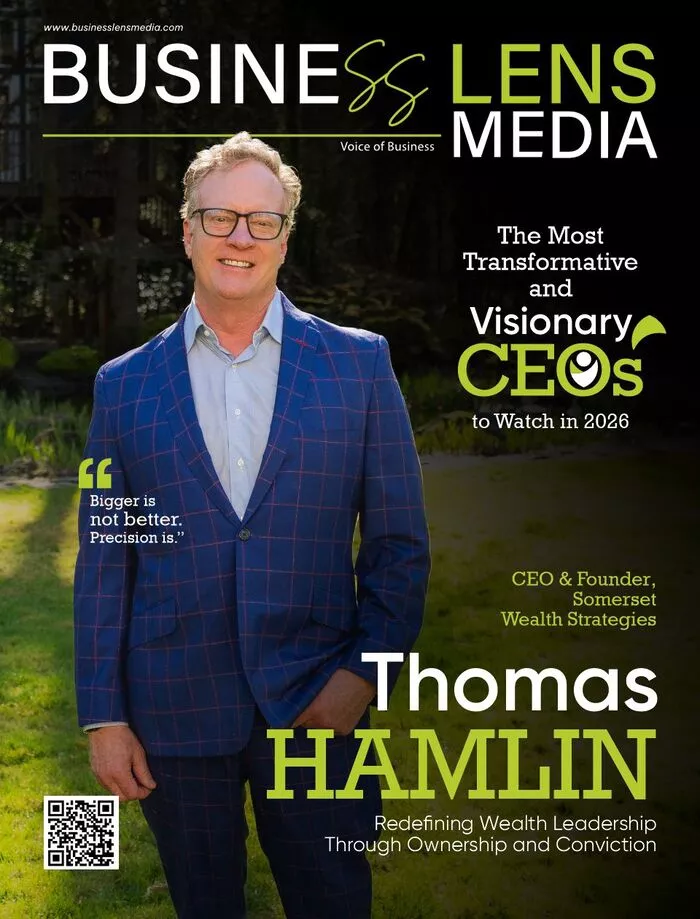
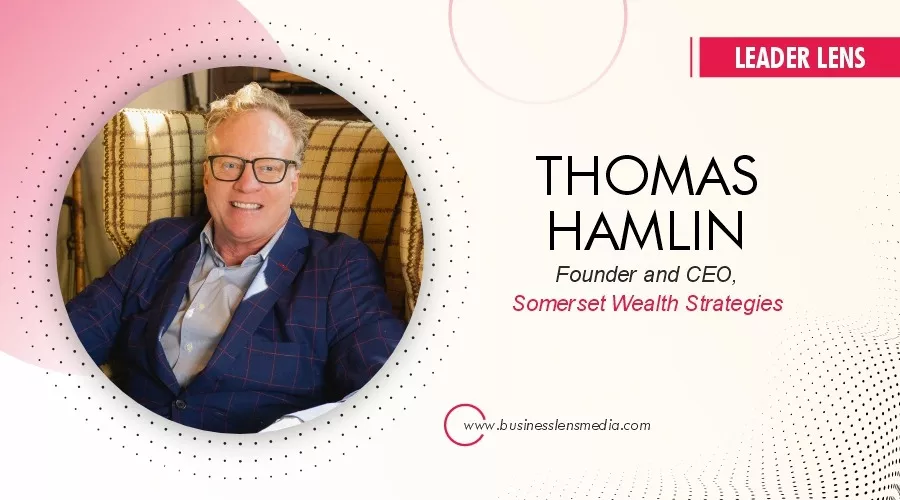
Over the course of more than three decades, Thomas Hamlin, CEO & Founder of Somerset Wealth Strategies, has navigated the financial advisory landscape with a perspective sharpened by experience. From his earliest days in a rapidly evolving advisory environment to leading a firm designed around independence and precision, his journey reflects a deliberate shift from participating in an enterprise to constructing one. Along the way, he confronted institutional barriers, legal battles, market volatility, and the complex realities of entrepreneurship, each chapter reinforcing a principle that would later define his leadership philosophy: clients deserve autonomy, and firms must be structured to protect it.
Today, Somerset stands not as a product of rapid expansion, but of intentional design. Its strategy blends disciplined growth with technological leverage, pairing advanced advisory systems with a focused service model that favors clarity over complexity. In an industry often driven by scale, Hamlin advocates precision. In a market driven by reaction, he prioritizes preparation.
As wealth management enters a decade defined by AI integration, regulatory intensity, and shifting investor expectations, his leadership reflects more than experience; it reflects foresight. Not merely adapting to change, but structuring for it. In a sector bracing for disruption, Thomas Hamlin is building for what comes next.
Discover how conviction, persistence, and precision shaped a CEO redefining what independence truly means.
Where It All Began: Earning Success Without Owning It
In wealth management, performance earns recognition, but ownership defines legacy. Thomas Hamlin learned that distinction early, and it went on to shape every strategic move that followed.
In 1990, he joined Independent Advantage Financial in Los Angeles, a firm that was ahead of its time in an unexpected way. Long before digital marketing reshaped financial services, the firm had already built a nationwide client base using newsletters to deliver annuity strategies across the country, quietly laying the foundation for the remote advisory model that now defines the industry. Most relationships were built remotely, without the need for in-person meetings, a model that now feels familiar but was unconventional then.
For Hamlin, the learning curve was steep. He had no prior experience in the industry. Yet within just over a year, he rose to become the top salesperson among 35 agents.
It was a remarkable achievement, but it came with a quiet frustration.
Despite his performance, there was no pathway to ownership. The founders were not interested in offering equity, even as he proved his value. It became clear that no matter how exceptional his performance, he would remain a builder without equity, creating enterprise value for others while limiting his own.
That realization didn’t push him out immediately, but it stayed with him.
The First Leap and the First Hard Lesson
By late 1994, the tension between ambition and limitation reached a breaking point. Hamlin and Jeff Oster, his mentor and the firm’s other top-performing salesperson, decided to leave together.
They explored opportunities with several major firms, eventually accepting an offer from Prudential Securities. On paper, it was the right move.
In reality, it became one of the most defining challenges of his early career.
The transition was mishandled from the start. Prudential failed to follow its strategic advice on how to bring clients over, and more critically, underestimated the determination of their former employer to retain those relationships.
What was meant to be acceleration became confrontation, a year defined not by expansion, but by litigation, negotiation, and a hard-earned understanding of institutional power.
For nearly a year, Hamlin and Oster found themselves fighting for the right to continue working with clients they had personally built trust with. The situation escalated to the point where Prudential had to compensate its former firm to resolve it.
It was a difficult chapter, but one that left Hamlin with a principle that would shape every decision going forward:
“Never sign an agreement where the client doesn’t have the right to decide who they can work with.”
It wasn’t just about contracts. It was about respecting the client relationship as something that belongs to the client, not the institution.
Somerset: A Company Built on Independence
By 1997, Hamlin had reached a point of clarity. After enduring what he describes as a ‘mostly miserable’ experience at Prudential, he and Oster made another move, this time with far more intention.
They are affiliated with a division of Raymond James, each opening their own branches. Oster relocated to New York, while Hamlin established himself in Palos Verdes.
This phase marked more than a career shift; it marked the beginning of ownership.
Around the same time, Hamlin reconnected with two former colleagues from his earlier days: Tom Harding and Mark Huntley. While Huntley joined Oster in New York, Harding remained with Hamlin, strengthening the foundation of what would soon evolve into a larger vision.
That vision took shape as Somerset Wealth Strategies, LLC, a name rooted in personal heritage drawn from the county in England where Hamlin’s father was born.
Somerset was never just a new firm; it was a structural reset. It represented control over strategic direction, uncompromised alignment with client interests, and the freedom to build an enterprise without institutional interference.
When reflecting on what inspired him to start his own company, Hamlin offers a perspective that is both candid and refreshing.
He suggests that entrepreneurs are not always the most naturally gifted or analytically superior individuals. Instead, they are defined by persistence, drive, and a willingness to endure challenges that most would avoid.
There’s also a certain blindness, he admits, a tendency to underestimate just how difficult it is to run a business.
He asserts, “You’re not just launching an enterprise, you’re assuming perpetual responsibility for its survival. Because once you’re in it, reality sets in.”
The Reality of Leadership: Beyond the Idealism
The image of entrepreneurship often leans toward freedom and control. Hamlin presents a more grounded version.
Running a company, in his experience, is less about freedom and more about responsibility.
It means covering significant operational expenses, ensuring that every member of the team is supported financially, continuously generating new business, and navigating an increasingly complex regulatory environment.
These pressures are constant, not occasional. And yet, he delivers this reality with a touch of humor:
“Other than that, it’s a little slice of heaven.”
That line captures something important. The challenges don’t diminish the experience; they define it.
A Leadership Style Built on Trust, Not Control
Hamlin’s leadership philosophy is shaped by both necessity and belief.
As the founder and the firm’s top producer, contributing over two-thirds of its revenue, he doesn’t operate like a traditional CEO. There isn’t time for micromanagement or constant oversight.
Instead of building hierarchy, he builds capability, structuring the organization around empowered leaders rather than centralized control.
He surrounds himself with individuals who are self-driven, accountable, and deeply committed to delivering exceptional outcomes for clients. These are not employees who wait for direction; they take ownership. His role, then, becomes one of strategic involvement rather than operational control. He steps in where decisions carry the most weight but trusts his team to handle the rest. That trust is not misplaced.
His core team reflects an unusual level of continuity:
- Andrew, his top lieutenant, has been with him for 22 years
- Derek, an advisor, for 14 years
- Meg, his assistant, for 12 years
- Kristen, office manager, for over 11 years
- Meagan, compliance manager, for more than a decade
Collectively, this group represents over 100 years of shared experience.
In an industry where turnover is often high, this level of retention is not accidental.
Hamlin invests heavily in people through training, mentorship, goal setting, and long-term growth pathways. Because he understands a simple truth: losing good talent is far more expensive than developing it.
Growth with Perspective: Why Bigger Isn’t Always Better
The company’s expansion accelerated in 2000, following Hamlin’s move to Lake Oswego, Oregon. It was during this phase that Somerset began building a broader team, extending its reach beyond a single location.
Over time, the company developed a distributed structure with team members across Portland, marketing professionals in multiple states, and strategic partnerships that extended its capabilities.
But growth brought its own lessons. Hamlin is clear in his view: scale, by itself, is not success.
“Bigger is not better,” he states, a contrarian stance in an industry obsessed with scale, but one rooted in decades of operational reality.
As organizations grow, complexity increases. Leaders become entangled in responsibilities that move them away from their strengths. Time shifts from value creation to management and oversight.
And perhaps most importantly, replicating one’s unique ability through others is far more difficult than it appears.
This realization has led Somerset to adopt a more measured approach, prioritizing effectiveness over expansion.
Evolving the Business Model: From Complexity to Clarity
Over the past three decades, Somerset’s offerings have evolved through multiple phases.
The firm began with a heavy concentration in annuities at one point, accounting for over 95% of its business. Over time, it expanded into mutual funds, life insurance, fee-based wealth management, alternative investments, and private placements. Each phase brought growth and learning.
Looking back, Hamlin describes this journey as a mix of “The Good, the Bad, and the Ugly.” Today, that experience has led to simplification.
His current philosophy is rooted in focus:
Keep it simple. Do fewer things, but do them exceptionally well.
As a result, Somerset now centers its strategy around two core platforms:
- Comprehensive annuity solutions across all categories
- Fee-based, fiduciary wealth management
These are complemented by select life insurance offerings and limited exposure to alternative investments.
This shift is not about limitation; it’s about precision.
Numbers That Reflect Strategy, Not Just Scale
Somerset’s performance reflects both its history and its direction.
The firm has consistently generated approximately $100 million in annual annuity premiums, while its fee-based wealth management division continues to grow, with $50 million in new assets projected for 2026.
More significantly, the firm has strengthened its recurring revenue base now well into the seven-figure range, with a clear path toward eight figures.
At the same time, past experiences, particularly during the COVID-19 pandemic, have influenced strategic decisions.
The firm has intentionally reduced exposure to certain alternative investments, especially those tied to real estate, recognizing the potential for future global disruptions.
This is not a reaction; it is preparation.
Technology as Leverage, Not Just Support
For Hamlin, technology is not a support function; it is a force multiplier. In an era where advisory firms risk obsolescence through inertia, Somerset treats AI and advanced software as strategic infrastructure, not experimentation.
Somerset has aligned itself with advanced technology partners to ensure its capabilities match those of much larger institutions. The firm has also made a deliberate commitment to AI, integrating it across workflows to enhance both efficiency and client outcomes.
The goal is ambitious but clear: Operate like a much larger organization without becoming one.
Hamlin often frames this mindset through a striking analogy: “Think Navy SEALs; lean, precise, and highly effective. That’s the model.”
Their investment in AI extends beyond tools and includes training. Their AI coach is regarded among the top business trainers globally, ensuring that adoption is not superficial but strategic.
Looking ahead, Hamlin believes the next decade will reshape the industry in ways most are underestimating.
And Somerset intends to be ahead of that curve.
Rethinking Risk and Return
One of Somerset’s key differentiators lies in how it blends traditional wealth management with annuity strategies.
By incorporating instruments like RILAs, the firm enables clients to increase equity exposure while maintaining downside protection. This approach allows for more aggressive growth positioning without proportionally increasing risk.
For example, a traditional 60/40 portfolio can be restructured into a 70/30 or even 75/25 allocation, while still aligning with the client’s risk tolerance.
At the same time, fixed annuities continue to offer competitive returns, often outperforming traditional fixed-income instruments.
Hamlin views the current rate environment as one of the most compelling income windows in decades, a moment he believes disciplined investors will either seize or regret.
With interest rates still relatively elevated (as of late 2025), guaranteed lifetime income products are offering payouts significantly higher than just a few years ago.
He describes this as a rare window that investors may not see again in their lifetime.
Resilience: Built Through Experience, Not Theory
Over the course of his career, Hamlin has navigated multiple market cycles from early 2000s volatility to the 2008 financial crisis and the global pandemic.
Each phase tested different aspects of the business.
While most of Somerset’s strategy proved resilient, not every scenario could be anticipated. Some lessons came later than expected, but they were no less impactful.
Today, Hamlin believes those experiences have fundamentally strengthened the firm.
“We’ve built a house that can withstand a Category 6 hurricane,” he says, contrasting it with firms built only for less extreme conditions.
It’s a metaphor, but one reinforced by navigating multiple systemic shocks that reshaped the industry.
The Philosophy That Endures
When asked about the secret to Somerset’s long-standing success, Hamlin doesn’t point to strategy, technology, or even market timing.
He points to something simpler and harder to sustain: Persistence.
Or, as he puts it more bluntly: Stubbornness.
But within that word lies a deeper meaning, an unwillingness to quit, a commitment to clients, and a belief that the work still matters.
Because at the core of Somerset’s journey is not just growth or survival, it is purpose.
A belief that there are still people who need guidance, who deserve thoughtful advice, and who benefit from a firm that puts their interests first.
Looking Ahead: Prepared, Not Predicting
The future of financial services will be shaped by forces that are still unfolding, like technology, regulation, global uncertainty, and shifting client expectations.
Hamlin does not claim to predict exactly how it will evolve. But he is confident in something else: Preparation.
After more than three decades in the industry, he has seen enough to understand that certainty is rare but readiness is possible.
In an industry facing accelerating disruption, readiness is no longer optional; it is decisive.
Thomas Hamlin is not building for the next quarter. He is building for the next era. And that is precisely why he stands among the most transformative and visionary CEOs to watch in 2026.