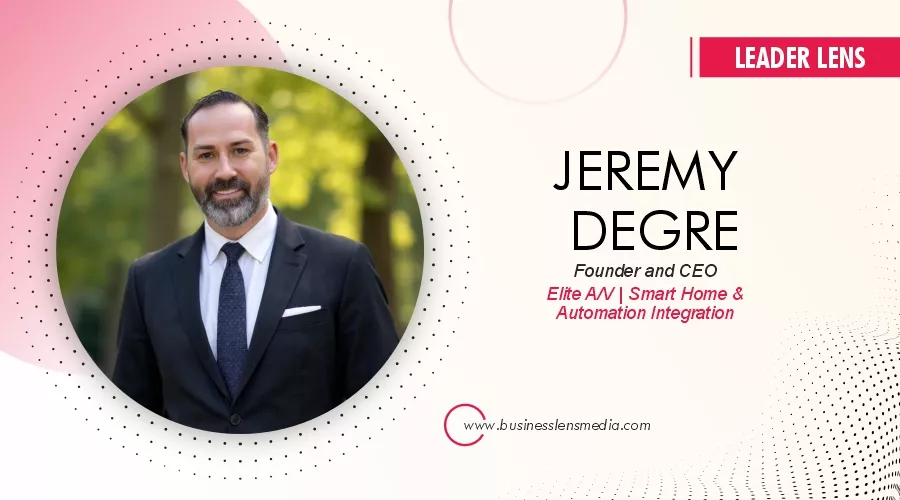
Jeremy Degre is the Founder and CEO of Elite A/V | Smart Home & Automation Integration, a Las Vegas-based technology integration company specializing in smart home automation, home theater, audio/video, lighting control, motorized shades, networking, security, and low-voltage infrastructure.
Working in the custom electronics industry since 1998, Jeremy has spent nearly three decades designing, programming, troubleshooting, and leading residential and commercial technology projects. His approach focuses on thoughtful engineering, reliability, simplicity, and creating systems that improve everyday life without overwhelming the people using them.
Under his leadership, Elite A/V has built a reputation for solving complex technology challenges, simplifying overengineered systems, and delivering high-performance integrated environments. Jeremy is also an industry voice and speaker focused on smart home technology, automation, artificial intelligence, leadership, and the future of connected living.
After nearly three decades in the smart home and custom integration industry, one lesson has become increasingly clear to me:
More technology does not automatically create a better experience.
In fact, some of the most frustrating systems I encounter are the ones that contain the most equipment.
Homeowners and commercial clients often assume that complexity is simply part of having sophisticated technology. I disagree.
A well-engineered system may be extremely complex behind the scenes, but the person using it should never have to feel that complexity.
That distinction matters.
A client should not need to understand video matrices, network architecture, control processors, signal paths, amplifiers, extenders, or automation logic just to watch television, play music, start a presentation, or adjust the lighting.
The engineering belongs behind the interface.
The experience should be simple.
Start With the User, Not the Equipment
One of the first questions I ask when evaluating a project is:
What are the people in this space actually trying to accomplish?
Not what the system could theoretically do.
Not how many products we can install.
Not how impressive the equipment rack can look.
What does the client need to do every day?
Sometimes the answer is surprisingly straightforward.
They want reliable music.
They want simple video.
They want lighting that responds naturally.
They want strong Wi-Fi.
They want security they can trust.
They want to press one button and have the right things happen.
That is where thoughtful integration begins.
Sophisticated Does Not Have to Mean Complicated
There is absolutely a place for advanced technology.
Large homes and commercial environments can require significant infrastructure, networking, automation, video distribution, lighting control, audio systems, security, and remote support.
But every additional component should have a reason to exist.
Every dependency creates another possible failure point.
Every unnecessary layer of complexity makes the system harder to service and harder for the client to understand.
Good engineering is not about maximizing the amount of equipment in a project.
It is about selecting the right technology, designing the right infrastructure, and creating a system that performs reliably for years.
Sometimes the smartest recommendation is to add technology.
Sometimes it is to replace outdated technology.
And sometimes the best solution is simply to remove complexity.
The Interface Is Part of the Engineering
One of the most overlooked elements of smart home and commercial AV design is the user interface.
A sophisticated automation platform controlled through a confusing remote or collection of unrelated apps is still a frustrating system.
The interface should reflect the way people naturally think.
Watch.
Listen.
Music.
Presentation.
Goodnight.
Away.
The homeowner, employee, guest, or resident should not need an instruction manual.
The system should adapt to the user, not the other way around.
Reliability Continues After Installation
Technology is not static.
Networks change.
Streaming services update.
Software evolves.
Equipment occasionally locks up.
That is why service and remote support should be considered part of the original system design, not something added only after a problem occurs.
Clients deserve to know that someone understands the system, can diagnose problems, and will still be there after the installation is complete.
That long-term accountability is part of the value of professional integration.
What True Luxury Technology Looks Like
Luxury technology is not defined by the number of devices installed or the amount of money spent.
The best systems often appear remarkably simple.
The equipment disappears.
The controls make sense.
The home responds naturally.
The client stops thinking about the technology altogether.
That is the standard I continue to pursue at Elite A/V | Smart Home & Automation Integration.
Because while technology will always become more sophisticated, the experience should become easier.
Complexity belongs in the engineering. Simplicity belongs in the experience.
Website & Professional Links
Elite A/V | Smart Home & Automation Integration
https://www.hometheater.vegas/
Jeremy Degre — LinkedIn
https://www.linkedin.com/in/jeremyndegre/
Elite A/V — LinkedIn
https://www.linkedin.com/company/hometheaterlv/
Las Vegas Review-Journal — Jeremy Degre / Elite A/V Feature
https://tinyurl.com/LVRJEAV
Marquis Top Business — Jeremy Degre Profile
https://tinyurl.com/MarquisWho