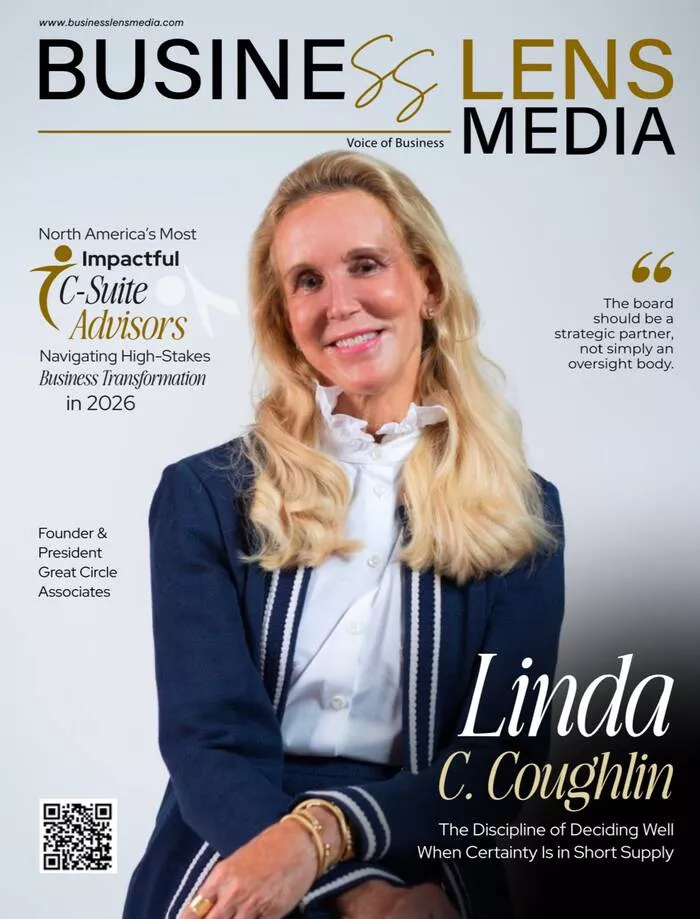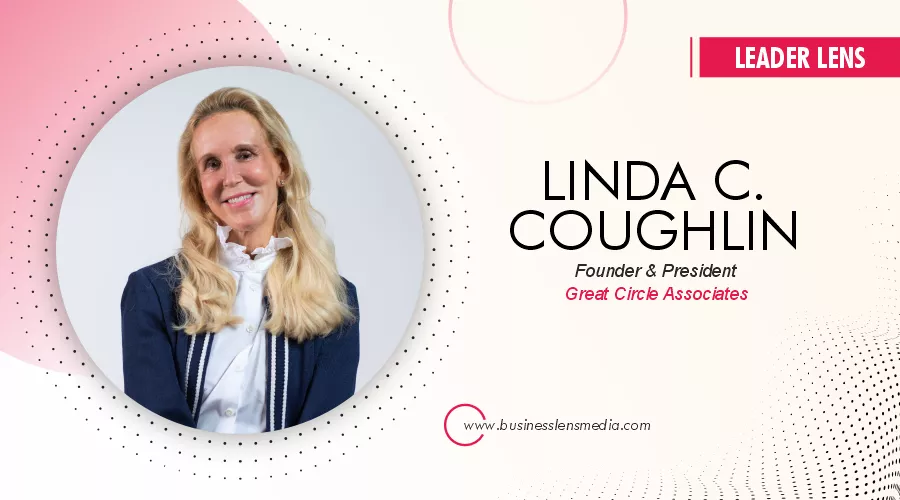
For Linda (Lin) Coughlin, the hardest business decisions are often not the ones with too few answers. They are the ones in which the problem itself has been framed incorrectly. That distinction sits at the center of Lin’s work as Founder and President of Great Circle Associates.
Her experience across operating leadership, board service and strategic advisory work includes the leadership of integrations resulting from mergers and acquisitions; IPOs, restructurings, divestitures, internal start-ups and new-market entries. She now brings that perspective to CEOs facing moments of high uncertainty, when the cost of a poorly framed decision can extend far beyond the original choice.
Her approach is notably different from the instinct to make every difficult decision faster. Before discussing the answer, she examines the question itself: What is the organization actually trying to decide? Who has a stake in the outcome? Which assumptions are driving the conversation? How reversible is the decision? And, perhaps most importantly, does the authority to make the call truly sit with the person making it?
“Hard decisions are often poorly framed problems,” Lin says. A binary choice may actually be a sequencing question. A human capital issue may be dressed up as a strategy question. A decision that feels urgent may simply be uncomfortable.
For Lin, the first job of an advisor is therefore not to help a leader choose. It is to help the leader see the decision correctly.
The Work Before the Choice
Operating and board experience has taught Lin that analytical merit is only one part of a high-stakes decision. A theoretically optimal strategy still has to survive the organization’s culture, incentives, power structure, and ability to execute.
That is why she weighs organizational and political reality alongside the numbers. The question is not merely, “What is the best option?” It is also, “Who needs to be brought along, and in what order, for this to actually happen?”
This shift from analysis to implementation is one of the defining features of her advisory perspective. A decision is not truly sound if the organization cannot carry it through.
She also distinguishes between decisions that are genuinely difficult to reverse and those that only feel that way under pressure. CEO succession, a public commitment, or a major capital structure change can create consequences that are difficult to unwind. Other decisions can be corrected after the fact.
That distinction helps leaders calibrate urgency rather than treating every high-stakes issue as an emergency.
Her board experience adds another layer. Governance has taught her to separate a leader’s confidence in their judgment from their authority to act alone. Some decisions belong to one executive. Others need the scrutiny of a board with fiduciary responsibility and broader accountability.
The practical question is straightforward: “Should you be deciding this alone?”
When the Organization Reaches an Inflection Point
At strategic turning points, CEOs often want to move faster. They may arrive with a preferred course already in mind and seek help executing it. Lin believes the highest-value intervention can be to slow the process down briefly before accelerating it.
Her first step is to clarify what problem the leader believes they are solving. Inflection points can be misdiagnosed as strategic when they are actually structural, or treated as urgent when they are primarily uncomfortable.
The distinction becomes more important when a CEO’s personal anxiety diverges from the organization’s actual risk. Concerns about reputation, difficult conversations, or appearing uncertain can subtly shape decisions away from the organization’s interests. Lin helps create distance between the executive’s emotional response and the organization’s objective exposure.
She also encourages CEOs to hear directly from their leadership teams. A CEO sees the business from a unique vantage point, but that vantage point can conceal fault lines. A candid executive-team pulse check, particularly where disagreement is safe to surface, can reveal concerns that might otherwise emerge only during execution.
The board should enter the conversation earlier than many executives feel comfortable with. Directors can contribute more when brought into live thinking rather than presented with a finished plan, allowing them to challenge assumptions and understand trade-offs before a decision becomes difficult to change.
And while all of this is happening, Lin believes CEOs must protect something increasingly scarce: uninterrupted thinking time. Strategic clarity is often needed most when operational fires are consuming the calendar. Without protected time to think, major decisions can be made in the margins between meetings.
Leading When Certainty Arrives Late
Lin’s experience across major transformations has reinforced a central reality of executive leadership: transformation frequently moves faster than certainty.
An acquisition may need to be finalized before every unknown is resolved. An IPO must be priced before the market has spoken. A restructuring begins before every second-order effect can be modeled. A new-market entry involves assumptions that cannot be fully tested in advance.
Effective leaders make decisions with incomplete information while building checkpoints to revisit them as facts change.
That requires another form of discipline: maintaining two horizons at once. The organization has to run the existing business while changing it. Customers still need service; employees still need direction; and the operating business still has to deliver results.
Lin advocates explicitly separating “run the business” from “change the business,” sometimes with different teams, cadences, and language. Without that separation, transformation can cannibalize the core operation, while the demands of the core operation can quietly stall the transformation.
Communication becomes equally important.
Employees, customers, investors and boards frequently want certainty that leaders do not have. Projecting more confidence than the evidence supports may create temporary reassurance, but it can damage trust when circumstances diverge from the message.
Lin favors a more candid approach: communicate what is known, what is not yet known, and when more will be known. Then update stakeholders as the situation develops.
That honesty is particularly important because transformation has an emotional and political dimension. Restructurings can create fear around jobs, status, and identity. M&A can generate turf anxiety and cultural friction. New-market expansion can challenge established assumptions about authority and identity.
Those reactions are not peripheral to strategy. They influence whether strategy gets executed at all.
Making Alignment Work
Lin’s collaborative, results-driven approach does not mean pursuing consensus indefinitely. She sees alignment as a structured process rather than an exercise in making everyone agree.
The first step is to name competing priorities explicitly. A CFO may be optimizing for near-term margin, a growth executive for market share, and the board for risk containment. Each objective may be legitimate. The problem is what happens when those trade-offs remain unstated and strategic disagreement becomes a proxy for bigger differences in priorities.
The next step is to distinguish decision rights from decision input. Many leadership disputes are jurisdictional disputes disguised as strategic debates. Teams move more effectively when there is explicit clarity about which decisions belong to the CEO, which require broader executive agreement, and which belong to the board.
Lin also favors establishing guiding principles before debating individual choices. Agreeing first on how decisions will be made can prevent every subsequent disagreement from becoming a referendum on values.
Stakeholder engagement should then be sequenced deliberately. Testing ideas with key individuals before a larger meeting can surface objections while there is still room to address them. The full-group conversation can then focus on resolving the remaining issues rather than discovering every disagreement in real time.
Importantly, dissent needs a legitimate channel. People should be able to challenge an idea before the decision is made. Once the decision is made, however, the expectation should be commitment rather than quiet resistance.
This is where Lin’s view of consensus becomes particularly useful. Consensus does not mean everyone gets their preferred outcome. It means people have genuine input and understand how the decision was reached.
The same principle applies to speed. More consultation is not automatically safer. Delay can carry real costs for customers, competitors, and employees. The leader’s responsibility is to weigh the value of additional alignment against the cost of waiting.
Knowing When a Fix Is Not Enough
Another recurring challenge in transformation is distinguishing a problem that needs immediate action from one that demands bigger change in strategy, culture, or operating model.
Lin approaches that distinction through diagnosis rather than the intensity of the moment.
Her first question is whether fixing the immediate issue would stop the underlying pattern from recurring. If it would, a tactical intervention may be sufficient. If similar problems continue to emerge in different teams, products, or periods despite repeated fixes, the organization may be dealing with a structural problem.
Severity alone is not the most useful diagnostic signal. Recurrence often is.
She also asks whether the organization’s operating model or culture produced the problem or merely failed to prevent it. A control gap may call for a new process. But if the organization’s underlying incentives reward short-term metrics in ways that repeatedly create long-term risk, the solution must go deeper.
Stakeholder expectations can make this harder. Boards, employees and markets often want visible action immediately, while structural change can take years. Lin therefore advocates two tracks: address the immediate risk while separately pursuing the deeper work.
A repeated quick fix is itself a warning sign. If a new policy, process, or hire keeps being used to address what appears to be the same problem, leaders should question whether they have been treating symptoms as causes.
The discipline, in her view, is to diagnose before acting, especially when pressure makes visible action feel irresistible.
Why Boards Matter to Transformation
Lin’s governance experience also informs her view that the board–C-suite relationship is not simply a matter of good governance practice. It can determine how well a transformation withstands pressure.
Major transformations rarely unfold exactly as planned. Assumptions fail, markets move, and integration can expose problems that were invisible during diligence.
A strong relationship allows executives to surface bad news and emerging risks earlier, when corrective options are still available. In a weak or adversarial relationship, management may delay disclosure until a problem becomes undeniable, narrowing the available choices.
Trust also changes what a board can contribute. An informed and engaged board can pressure-test management’s logic, offer pattern recognition from other companies and business cycles, and identify blind spots. It becomes a strategic resource rather than merely a body reviewing decisions after the fact.
That trust also gives management room to take necessary risks. Transformations can involve near-term margin pressure or an uncomfortable restructuring in pursuit of a longer-term objective. A board that understands the strategy can distinguish temporary pain from evidence that the strategy is failing.
The relationship sends a signal beyond the boardroom, too. Employees, investors and markets notice visible disagreement between directors and management. Alignment does not require unanimity. It requires a shared understanding of the strategy and confidence in the process.
When that foundation exists, board-level decisions involving succession, capital allocation and risk can move at the pace the transformation requires.
The Personal Discipline of Perspective
There is a personal dimension to Lin’s philosophy: sustained judgment requires sustained perspective. She believes perspective needs structural protection rather than occasional recovery. A trusted outside voice, protected time away from the immediate crisis, and routines unrelated to work can create distance from the pressure system.
Leaders also need to separate identity from outcome. A failed transaction, difficult restructuring, or unfavorable board decision can matter enormously without becoming a verdict on personal worth. When identity becomes tied too closely to outcome, decisions can begin protecting ego rather than serving the organization.
Lin also encourages leaders to widen their time horizon. Acute stress naturally narrows attention toward the immediate threat. Asking how a situation might look in a year or five years can interrupt that tunnel vision without minimizing the problem in front of them.
Doubt, too, deserves a more useful place in leadership. Executives facing genuine uncertainty may assume they are supposed to feel certain. That expectation can produce false bravado or private anxiety. Recognizing doubt as a normal part of consequential decision-making can make it easier to work with uncertainty rather than conceal it.
Reflection is another discipline. Quiet time is not necessarily reflective time if it is simply more problem-solving. Genuine reflection creates space to notice patterns, question assumptions, and recognize when fear has begun replacing judgment.
The Next Set of C-Suite Tests
The challenges facing North American leaders in 2026 reinforce many of the themes that run through Lin’s work.
Economic and geopolitical uncertainty is making strategic commitments harder. Artificial intelligence has become both a major investment priority and a potential source of strategic risk. CEOs are increasingly questioning the business model itself rather than limiting their attention to incremental efficiency.
Workforce resilience is also moving higher on the leadership agenda, with skills, leadership development and employee mental health becoming increasingly important as technological and structural change accelerates.
Sustainability presents a different kind of challenge, particularly as political and legal scrutiny changes the environment for ESG commitments. Leaders must navigate reputational and regulatory exposure without losing sight of substantive issues such as resource efficiency, circularity and clean technology.
Across these challenges, the common problem is making consequential choices while certainty remains incomplete.
Lin’s advice is to design disciplines that hold under pressure.
Leaders should anchor transformation to a small number of non-negotiable priorities and use them as a filter for new opportunities and threats. They should treat transparency as a strategic asset rather than a vulnerability. Board relationships should be developed before a crisis requires them.
They should also distinguish the pace of decision-making from the pace of implementation. Some decisions need to happen quickly. Implementation may need patience so that assumptions can be tested, stakeholders can adapt, and changes can stick.
And leaders should measure organizational capacity alongside organizational output. A transformation that hits its financial milestones while exhausting key people, eroding trust or weakening the leadership bench may have succeeded on paper while making the organization less resilient.
Finally, transformation plans should contain genuine reassessment points. Reconsidering a strategy when new information emerges is not necessarily wavering. It can be the difference between conviction and stubbornness.
Leading Without Pretending to Know Everything
The consistent thread in Lin’s work is not a particular strategy for transformation. It is a discipline of judgment.
Her experience has taught her that high-stakes leaders cannot wait for complete information, but neither should they confuse speed with decisiveness. They need to know which decisions require broad alignment and which require clear authority. They need to involve boards before problems become crises and understand that organizational emotions can determine whether a strategy succeeds.
Most of all, they need the ability to remain clear-headed when circumstances encourage the opposite.
The strongest leaders, in Lin’s view, are not those who project certainty. They are those who can tolerate ambiguity without freezing, communicate honestly without undermining confidence, and change course without losing conviction.
That is particularly relevant to the next phase of business transformation in North America. Executives are being asked to make harder choices across capital, technology, business models, workforce strategy and public commitments, often without the clarity they would ideally like.
Lin’s response is not to promise certainty.
It is to make better judgment possible in its absence.
That begins by finding the real decision, understanding who needs to be involved, distinguishing reversible choices from irreversible ones and creating enough space to think before acting. It continues through transparent communication, disciplined governance, genuine stakeholder alignment, and a willingness to revisit assumptions.
For leaders navigating high-stakes transformation, that may be the more durable advantage: not knowing every answer in advance, but building the judgment, structure, and resilience required to make the next decision well.