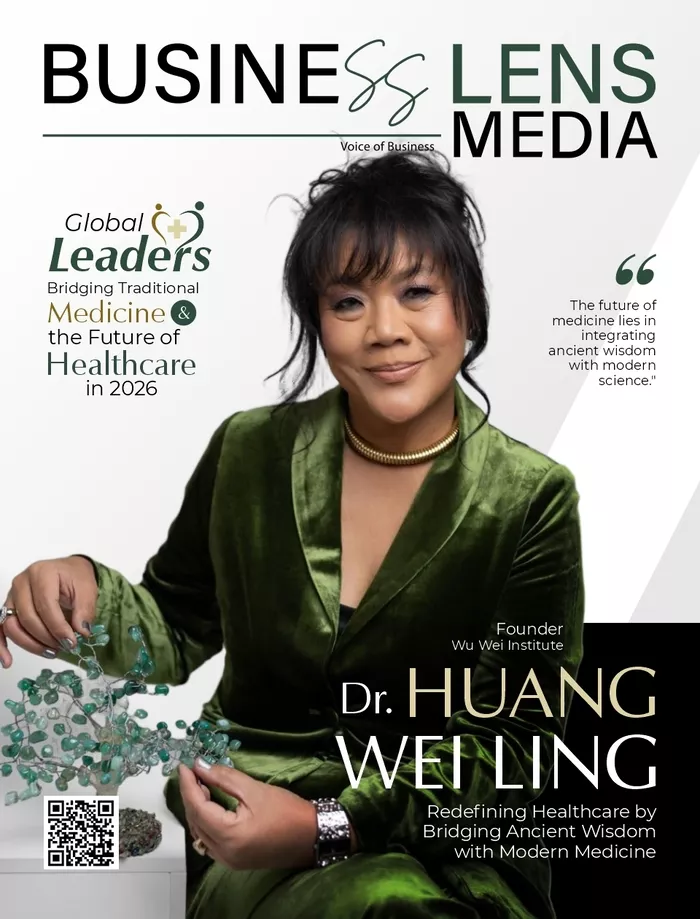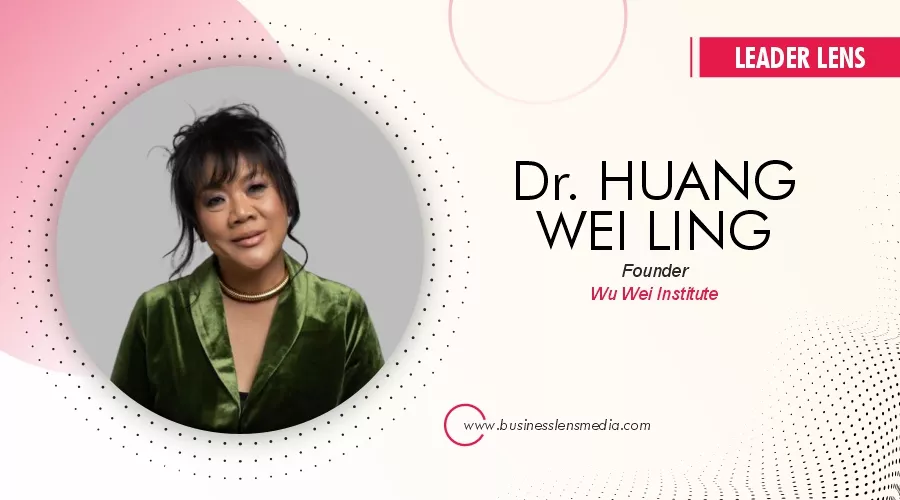
For more than three decades, Dr. Huang Wei Ling has pursued a question that continues to shape her life’s work: What if the visible symptoms of disease are only part of the story?
As the Founder of the Wu Wei Institute and creator of the Wu Wei Protocol, Dr. Huang has built a career around integrating Traditional Chinese Medicine, acupuncture, homeopathy, Chinese nutrition, and modern Western medicine into a unified approach to healthcare. Her philosophy challenges the conventional tendency to focus primarily on symptoms, encouraging healthcare professionals to look deeper into the underlying causes of illness.
“To truly heal, we must treat the person rather than merely suppress the disease.”
Her work reflects the spirit of this edition, Global Leaders Bridging Traditional Medicine and the Future of Healthcare in 2026, advocating for a healthcare model that combines the strengths of traditional healing systems with scientific inquiry. Rather than viewing these disciplines as competing philosophies, she believes they can work together to deliver more comprehensive, patient-centered care.
From Conventional Medicine to a Broader Vision of Healing
Dr. Huang’s medical journey began in 1992 after graduating from the State University of Londrina in Brazil. Determined to understand the human body as an interconnected system rather than through isolated specialties, she chose to specialize in Infectious and Parasitic Diseases, a field that exposed her to a wide range of medical conditions across multiple disciplines.
Her expectations, however, quickly met a different reality. During her residency, she spent much of her time caring for critically ill AIDS patients at a time when effective pharmaceutical treatments remained limited. Witnessing entire wards filled with severely weakened patients profoundly influenced her understanding of medicine and reinforced her determination to seek better approaches to patient care.
Another defining experience came in the intensive care unit, where she developed a strong interest in clinical nutrition. She became actively involved in calculating nutritional requirements for critically ill patients and later represented resident physicians on the hospital’s Nutritional Support Committee. Early research under nutrition specialist Dr. Maria Izabel Ceribelli also introduced her to scientific investigation, laying the groundwork for a research career that would later span decades.
After completing her residency in 1995, Dr. Huang joined a public hospital in Franca, São Paulo, where she led antimicrobial stewardship initiatives. By introducing clear prescribing protocols and standardized documentation, she significantly improved physician adherence to antibiotic guidelines. The project later received national recognition at the Brazilian Congress on Hospital Infection Control in 1998, competing alongside initiatives from nearly 500 hospitals across the country.
The experience reinforced an important lesson that continues to guide her leadership today: meaningful healthcare improvements are often driven not by greater resources, but by observation, discipline and the willingness to improve existing systems.
A Turning Point Toward Traditional Chinese Medicine
One conversation with her mother would ultimately redirect the course of Dr. Huang’s career.
Shortly after moving to Franca, her mother encouraged her to study Traditional Chinese Medicine, believing it would become increasingly important in the future of healthcare. Although unconventional at the time, that advice became one of the most influential moments in Dr. Huang’s professional journey.
As she immersed herself in acupuncture, Chinese herbal medicine, and Chinese dietary therapy, she encountered a fundamentally different way of understanding disease. Instead of focusing exclusively on abnormalities identified through laboratory tests and imaging, Traditional Chinese Medicine emphasized recognizing functional imbalances that may precede the development of physical illness.
Rather than replacing her Western medical training, this perspective expanded it.
She began observing patients whose conditions were not responding as expected to conventional treatments and found that integrating Traditional Chinese Medicine often provided additional insights into their overall health.
These experiences gradually shaped a philosophy that continues to define her work today.
“Symptoms are often only the visible portion of a much larger process. Understanding the root allows physicians to treat the whole person instead of isolated conditions.”
Dr. Huang believes many chronic health conditions cannot be fully understood by examining symptoms alone. Instead, she advocates identifying and addressing the underlying causes that contribute to disease before they progress further.
Her approach views the human body as an interconnected system in which physical, functional, and energetic balance all influence overall health. This holistic perspective has become the foundation of her work in acupuncture, Chinese nutrition and integrative medicine.
The Birth of the Wu Wei Protocol
Dr. Huang’s multidisciplinary background eventually inspired one of her most significant contributions to integrative healthcare.
While studying homeopathy in 2015, she observed that many treatment decisions relied heavily on matching remedies to symptoms. Drawing upon her extensive training in Traditional Chinese Medicine, she sought a more systematic approach that focused first on identifying the underlying causes of illness.
She often explains this philosophy using the analogy of a tree.
Rather than treating only the leaves, physicians should first understand the condition of the roots.
According to Dr. Huang, symptoms are visible expressions of deeper imbalances. By restoring balance at the root, multiple conditions may improve simultaneously rather than being managed individually.
This philosophy became the basis for the Wu Wei Protocol, a methodology designed to address what she considers the underlying causes of disease through an integrative framework centered on restoring balance within the body’s core systems.
One of the concepts introduced through her research is what she describes as New Global Immunodeficiency, a theory proposing that modern lifestyles have contributed to widespread depletion of the body’s internal energy. Her protocol seeks to restore this balance through acupuncture, Chinese dietary therapy, and highly diluted therapeutic approaches intended to support the body’s natural healing capacity.
Drawing inspiration from Hippocrates’ belief that “the natural forces within us are the true healers of disease,” Dr. Huang views the Wu Wei Protocol as a complementary approach that strengthens the body’s own restorative mechanisms rather than replacing conventional medicine.
For her, the future of healthcare lies not in choosing between traditional medicine and modern science, but in thoughtfully integrating both to create more comprehensive, personalized care.
This philosophy has become the driving force behind her research, clinical practice, and educational efforts, while also positioning her as a leading advocate for integrative medicine on the global stage. In recent years, her work has taken her beyond the clinic and into international scientific forums, where she continues to encourage healthcare professionals to rethink how medicine can evolve to meet the changing needs of patients worldwide.
Advancing Integrative Medicine on the Global Stage
For Dr. Huang Wei Ling, research has never been confined to laboratories or academic journals. Every patient encounter has served as an opportunity to question, observe, and refine her understanding of health and disease. Over the past three decades, she has continued to expand her knowledge across multiple disciplines, including Traditional Chinese Medicine, homeopathy, acupuncture, Chinese herbal medicine, Chinese dietary therapy and Ayurveda, always seeking meaningful connections between ancient healing principles and modern clinical practice.
Her objective has remained consistent: to encourage healthcare professionals to look beyond isolated symptoms and adopt a more comprehensive understanding of the patient.
“The future of medicine lies in understanding the whole person, not just the organ where symptoms appear.”
This philosophy has guided both her research and her efforts to promote greater acceptance of integrative medicine within the global healthcare community. Through scientific publications and presentations at international conferences, she has encouraged physicians to remain open to perspectives that complement conventional medical practice while continuing to uphold scientific inquiry and patient-centered care.
Among the milestones in her academic journey was presenting her research at a Harvard acupuncture research conference in Boston in 2015. She has also shared her work at conferences across the United States, including Baltimore, Michigan, Atlanta, San Diego and Washington, D.C., as well as in more than 40 countries worldwide.
Throughout these engagements, her message has remained remarkably consistent: healthcare must continue evolving alongside the changing needs of patients, and physicians should never stop learning.
Clinical Practice as the Foundation of Innovation
Unlike many researchers who spend most of their careers in academic settings, Dr. Huang believes meaningful innovation begins in the clinic.
She argues that physicians actively treating patients are often the first to recognize emerging patterns that cannot always be explained through existing medical frameworks. According to her, remaining connected to everyday clinical practice allows researchers to continually reassess treatment approaches as patient populations evolve.
One case, in particular, became a defining moment in her career.
A 70-year-old man sought treatment after experiencing persistent leg pain for six months despite prolonged use of anti-inflammatory medication. Instead of focusing solely on pain relief, Dr. Huang evaluated the broader patterns identified through Traditional Chinese Medicine and treated what she believed were the underlying imbalances using body acupuncture, auricular acupuncture, and individualized dietary guidance.
The patient’s leg pain improved considerably. More unexpectedly, his ophthalmologist documented a dramatic reduction in intraocular pressure associated with glaucoma from more than 40 mmHg to 17 mmHg for the first time in nearly four decades.
For Dr. Huang, the experience reinforced her belief that interconnected imbalances may influence multiple conditions simultaneously, even those unrelated to a patient’s primary complaint.
It also strengthened her commitment to documenting clinical observations and sharing them with the broader medical community.
She believes healthcare professionals should remain willing to reassess long-standing assumptions as new clinical evidence emerges.
“Graduation is not the end of medical education. It is only the beginning of a lifetime of learning.”
Recognition Rooted in Humility
Dr. Huang’s dedication to integrative medicine has earned her international recognition, including the Nobel Scientist Award in Acupuncture and Homeopathy. While she considers the honor deeply meaningful, she views it less as a personal achievement than as a reminder of the responsibility that accompanies continued research.
“The moment we believe we already know everything is the moment we stop growing.”
Despite decades of clinical experience, international presentations and scientific publications, she continues to approach medicine with humility, believing that every patient and every discovery offers another opportunity to learn.
That same philosophy shapes her leadership at the Wu Wei Institute, where research, education and patient care work hand in hand to advance a more integrated model of healthcare.
Leading with Purpose
Balancing research, patient care and education requires discipline, collaboration and resilience. For Dr. Huang, maintaining that balance begins with faith, personal well-being and a strong support system.
She starts each day with exercise, enjoying activities such as beach tennis and Tai Chi Chuan, practices that help her maintain both physical and mental balance amid a demanding schedule.
Equally important is the multidisciplinary team she has built at the Wu Wei Institute. Together, they continue advancing the institute’s mission of improving health through acupuncture, Chinese nutrition and the Wu Wei Protocol while encouraging greater understanding of integrative medicine worldwide.
Rather than pursuing rapid transformation, Dr. Huang believes lasting change is achieved gradually through education, collaboration and consistent patient care.
A Vision for the Future of Healthcare
Looking ahead, Dr. Huang believes healthcare is entering a new era in which collaboration between traditional healing systems and modern medical science will become increasingly important.
Her long-term vision extends beyond expanding the Wu Wei Protocol. She hopes to contribute to a healthcare model that places greater emphasis on prevention, personalized care, and identifying the underlying causes of disease rather than focusing exclusively on symptom management.
Drawing inspiration from Hippocrates’ enduring philosophy, she believes physicians should strive to treat the individual rather than simply the diagnosis.
“Medicine reaches its highest purpose when it treats the person, not simply the disease.”
She also encourages healthcare professionals to recognize that graduating from medical school is only the beginning of their professional development. Continuous education, interdisciplinary thinking, and openness to new knowledge, she believes, are essential qualities for the next generation of healthcare leaders.
Her advice to young physicians and researchers reflects the same mindset that has guided her own career.
She encourages them to respect the scientific foundations established by previous generations while remaining curious enough to explore new ideas that may deepen humanity’s understanding of health. Above all, she reminds them that the trust patients place in healthcare professionals carries an enduring ethical responsibility.
“Every physician should remain a student throughout life. The moment we stop learning is the moment we stop serving our patients as they deserve.”
Bridging Tradition and Tomorrow
Dr. Huang Wei Ling’s career reflects a lifelong commitment to exploring how ancient medical wisdom and modern scientific thinking can work together to improve patient care. From her early years in infectious diseases and hospital nutrition to the development of the Wu Wei Protocol and her international research initiatives, she has consistently advocated for a more integrated understanding of health.
Her work continues to contribute to the growing global conversation surrounding preventive, personalized, and integrative medicine. By encouraging collaboration rather than division between traditional healing systems and conventional healthcare, she represents a leadership approach grounded in curiosity, lifelong learning and compassionate patient care.
As healthcare continues to evolve, Dr. Huang remains committed to a vision in which medicine embraces both scientific advancement and holistic understanding, bringing the world one step closer to a future where healthcare is not only more innovative, but also more human.