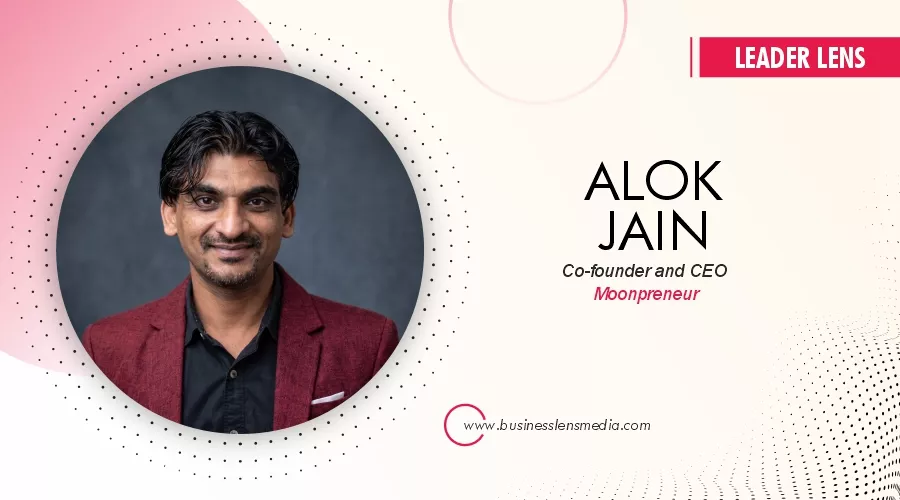
Alok Jain is the Co-founder and CEO of Moonpreneur, an ed-tech company helping students aged 7–18 build real-world skills in robotics, coding, and entrepreneurship. Since founding Moonpreneur in 2020, he has scaled it from 40 students to a global community of 66,000+, driving outcomes (primarily in the USA, but also in the UK, Canada, Australia, India etc.) including 2,000+ student pitches to industry professionals and 50+ youth-led startups launched and incubated. Through the Entrepreneurship and Leadership Development Program (ELDP), built in partnership with IITs and IIMs, he has extended that impact to 18–23-year-olds across India and South America.
Before Moonpreneur, Alok co-founded eZdia, led marketing for Walmart.com’s multi-billion-dollar channel, and worked as a product engineer at Texas Instruments and Infineon Technologies. A graduate of IIT Bombay who grew up in Damoh, a tier-3 city in Madhya Pradesh, he believes opportunities aren’t found but built.
Three years ago, if you’d told a hiring manager that a high schooler’s GitHub commits or a debate video would matter more than their resume, you’d have gotten a polite laugh. Nobody’s laughing now.
We’re watching two major shifts converge, and together they’re rewriting how young people get discovered, and how institutions decide who’s real. On the hiring side, 69% of companies now use AI in talent acquisition in some form, scouting for proof-of-work signals long before a candidate ever applies. The flip side is a trust crisis: Gartner projects that by 2028, one in four candidate profiles globally could be fake. When fabrication gets that easy, the applicants who win are the ones with a verifiable trail of real work.
Admissions offices are moving in the same direction. About 50% now use some form of AI in review, and it’s gone well past plagiarism checks; Caltech runs applicants through an AI video interview to verify their research is genuinely theirs; UNC has been running automated essay scoring since 2019. They’re no longer just reading what a student wrote. They’re verifying whether it’s true.
Put those trends together and the conclusion is obvious: authenticity, not polish, is becoming the currency of opportunity. A student who built a robotics prototype or pitched a startup idea has real proof sitting in a drawer somewhere, unindexed, invisible to both the recruiter’s LLM and the admissions officer’s AI reader. That’s not a talent gap. It’s a documentation gap.
But documentation is only half the answer. Proof of work matters because someone is judging it against a destination, a college, a career, a track. So the harder question isn’t just “how do we capture what a student has done,” it’s “how do we help them see what it’s building toward.”
Degree requirements in job postings have already dropped from 46% to 41% in the past few years, opening over a million roles to candidates without a four-year degree. More than 65% of executives now say their organizations prioritize skills-based assessments over degrees. That’s the real shift underneath the resume’s decline: it’s no longer a straight line from college to career. It’s college, or a certification, or an apprenticeship, or a venture a student built themselves, and a portfolio is what makes any of those pathways credible.
This is exactly why we built our student portfolio initiative, and why we built it to change shape as a student grows, instead of treating a second-grader and a graduating senior the same way.
For our young innovators (7–10), the goal is habit, not achievement: capturing curiosity in motion, first robotics builds, first game, first math competition, so there’s a documented starting point instead of a blank slate later. For our middle-years students (11–14), the portfolio shifts from “look what they tried” to “look what they can do,” as debate performances, product designs, and early pitches start adding up to a real body of work, and the first signs of direction start to show. And for our college-track teens (15–18), it becomes leverage: startup pitches, internships, competition results, the exact proof-of-work an admissions AI reader or a recruiter’s LLM will actually be scanning, now pointed at a clear pathway rather than a scattered list of achievements.
One initiative, three very different jobs. That’s not a design flourish but the whole point. A portfolio that ignores how differently a 7-year-old and a 17-year-old need to be represented isn’t solving the findability problem. It’s just a prettier resume.
Hundreds of our students already have portfolios live, and the number is growing every week. This launch is still an intermediary version; we have more updates in development, and we’re building this alongside our community’s feedback, not ahead of it.