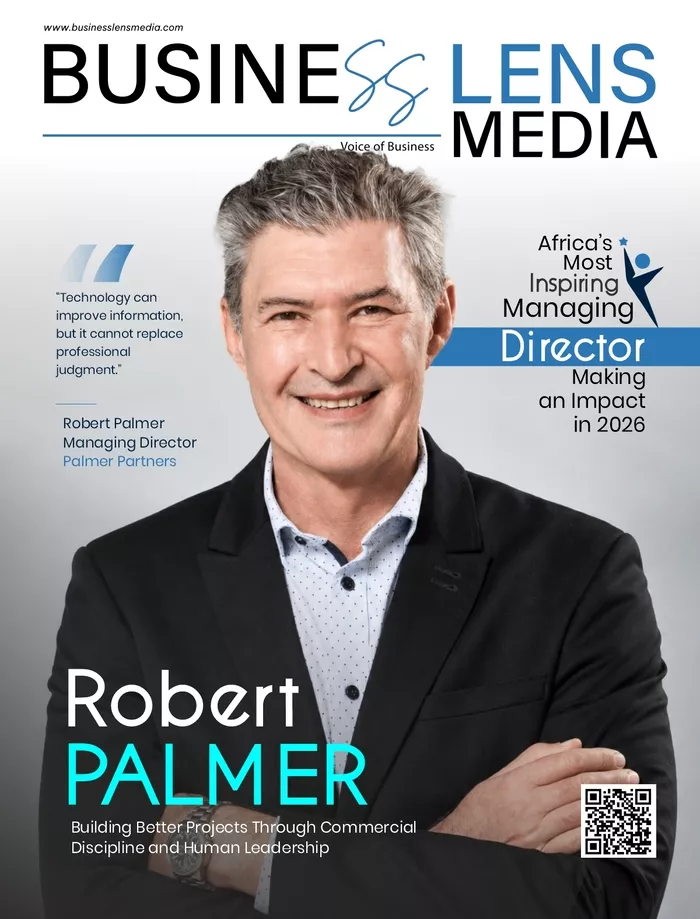
For Robert Palmer, leadership was not learned in a boardroom. It was built over decades of working where budgets, deadlines, contracts, technical decisions and people converge. Since beginning his professional career in 1996, Robert has worked across quantity surveying, project management, project controls and the broader built environment, gaining experience across infrastructure, rail, mining, industrial, marine and property projects. Today, as Managing Director of Palmer Partners, he brings that breadth of experience to a business built around a straightforward premise: better project outcomes begin with better decisions.
Robert’s professional credentials reflect the depth of that experience. He is a professionally registered quantity surveyor and holds BSc(QS), PrQS, PMAQS, MRICS and ICECA designations, alongside accreditation as an RICS Accredited Valuer. He is also involved in professional development within the quantity surveying profession as a supervisor, mentor and assessor.
Yet his perspective on leadership extends beyond qualifications and technical expertise. For Robert, the real responsibility of a leader is to bring people, information and decisions together around a common objective. That philosophy has become increasingly relevant in a sector where the success of a project depends on far more than whether a design looks right or a budget appears attractive at the outset.
From Measuring Cost to Understanding Value
Quantity surveying gave Robert his first strong commercial foundation. The discipline taught him to understand the relationship between cost, value, risk and performance, but experience on increasingly complex projects broadened that perspective.
Project management required him to look beyond individual cost components and understand the complete project environment: people, procurement, programme, quality, contracts, technical requirements and the client’s strategic objectives. Over time, he came to see that these factors cannot be treated independently.
A technically excellent design can still fail commercially. A project that looks financially viable at the beginning can encounter serious difficulties when risks, programme constraints or stakeholder requirements have not been properly considered. That understanding shaped Robert’s approach to leadership and ultimately influenced the way he built Palmer Partners.
The firm’s multidisciplinary model brings together quantity surveying, project management, project controls, programme management, feasibility, development advisory and related commercial services. Its purpose is not simply to provide separate technical functions, but to help clients make connected decisions throughout the project lifecycle.
That perspective remains central to Robert’s own leadership philosophy.
“Leadership is ultimately about taking responsibility, making informed decisions and bringing people together around a common objective,” he says.
It is a definition grounded less in authority than in accountability.
Leadership That Creates Ownership
Robert does not view inspiring leadership as having every answer. Instead, he believes leaders should create the conditions in which capable professionals can perform at their best.
That requires clarity, trust, accountability and a willingness to listen. It also requires people to understand why their work matters. In a project environment, where architects, engineers, contractors, consultants, clients and commercial teams must operate together, that shared understanding can make the difference between isolated activity and coordinated delivery.
At Palmer Partners, teamwork, transparency, accountability and respect are therefore treated as practical operating principles rather than abstract values.
Robert also believes leadership must be visible in behavior. If a business expects its people to be professional, commercially aware and accountable, those standards have to appear in its relationships with clients, consultants, contractors and colleagues.
His goal is to develop teams that do not simply react when something goes wrong. They should be able to identify potential problems early, communicate them clearly and work toward practical solutions.
That emphasis on ownership is particularly important in a profession where decisions made by one discipline can quickly affect the work of another. Good leadership, in Robert’s view, means creating enough trust for people to raise concerns early while maintaining enough accountability to ensure those concerns lead to action.
The Discipline Behind Better Decisions
For Robert, commercial performance does not mean reducing costs at every opportunity. It means understanding what the client is trying to achieve and ensuring that the available investment produces the right outcome.
That begins with defining success.
Projects differ in their priorities, but scope, cost, time, quality, risk and operational requirements typically compete for attention. The challenge is to manage those competing considerations using reliable information rather than assumptions.
This is where Robert’s quantity surveying background intersects with his broader project-management philosophy. Early feasibility work can establish realistic expectations around construction and consultant costs, programme requirements, anticipated end values and project risks. As the project develops, cost planning, procurement, tender evaluation, change control, progress monitoring, forecasting and contract administration provide an increasingly detailed picture of its financial and operational position.
The objective is not to chase the lowest possible number. It is to understand what each decision means.
A specification change can affect quality and lifecycle performance. A procurement decision can influence both cost and programme. A delay can create consequences far beyond the immediate construction period.
Robert therefore sees cost management as a value discipline. The question is not simply, “How much can we save?” but rather, “What outcome are we trying to achieve, and what is the best use of the investment available?”
That distinction has also become part of Palmer Partners’ wider professional positioning. The firm describes its approach as integrating quantity surveying, cost management, project management and project controls to help clients manage projects from feasibility and development planning through procurement, construction and final account.
Seeing Risk Before It Becomes a Problem
Complexity is one of the defining characteristics of the built environment. Projects bring together multiple stakeholders, technical interfaces, contractual obligations, regulatory requirements, changing expectations and commercial pressures.
The challenge, Robert believes, is often not spotting an individual risk but understanding how one decision can affect several other areas.
That has made early risk identification a defining feature of his approach. Rather than waiting for issues to become claims, delays or cost overruns, he favors documenting, assessing and assigning risks while there is still room to respond.
Palmer Partners’ project-controls approach includes risk registers and assessment, scheduling, cost control, value engineering and performance monitoring, among other disciplines.
There is also a pragmatic element to Robert’s decision-making. In real projects, perfect information rarely exists. Leaders sometimes have to make considered decisions using the information available, while understanding the assumptions and consequences involved.
For Robert, transparency is therefore as important as certainty. Decisions should be understood, their effects monitored and their direction adjusted when new information changes the picture.
That mindset has been tested across an unusually broad professional career. His experience includes large multidisciplinary engineering projects, mining and materials-handling environments, rail and infrastructure, marine projects and property. His publicly documented project experience includes work connected with Transnet, Eskom’s Medupi and Kusile power stations, mining projects and major property developments.
Experience That Crosses Industries
Working across sectors has given Robert an appreciation for how different project environments can be, while also revealing the common disciplines required for successful delivery.
Mining and industrial projects bring their own technical and operational complexities. Infrastructure and rail projects introduce extensive interfaces, stakeholder requirements and long-term programme considerations. Property projects create different pressures around development feasibility, design, procurement and market expectations.
Across those environments, Robert’s role has repeatedly required him to connect technical information with commercial decision-making.
That breadth has influenced how he views professional credibility. The value of an adviser, he believes, lies not only in knowing the detail but in understanding how that detail affects the larger project.
His professional experience has also included financial audits, claims consultancy and project controls. On his LinkedIn profile, Robert documents assignments involving major infrastructure and industrial projects, including financial forensic work and contract-related assessments.
These experiences have reinforced an important lesson: commercial decisions rarely exist in isolation. A contract clause can influence financial exposure. A procurement choice can influence programme risk. A technical change can alter the final cost.
The strongest professionals are therefore those who can see beyond the boundaries of their own discipline.
Building Palmer Partners Around a Bigger View
Robert established Palmer Partners in 2017, developing the business around a client-focused model that combines technical expertise with commercial and project-management capability.
The evolution of the business reflects his broader view of what clients need from professional advisers. Rather than receiving isolated technical outputs, clients increasingly require coordinated insight across feasibility, cost, procurement, delivery and risk.
The firm’s service capabilities span quantity surveying, cost management, project management, project controls, programme management, procurement, contract administration, feasibility and development advisory.
Technology is part of that evolution, but Robert is careful about its role. He sees digital tools and project data as enablers rather than substitutes for professional judgment. Better information can improve forecasting, expose trends earlier and support more informed decisions, but technology still needs to be interpreted within the realities of a project.
That balance between technology and judgment is increasingly important as the built environment becomes more data-driven.
For Robert, staying relevant means investing in people, adopting useful technology and remaining close to the problems clients are actually trying to solve.
Developing People Alongside Projects
One of the less visible dimensions of Robert’s professional contribution is his involvement in developing the next generation of quantity surveying professionals.
He has served as a mentor and has been an approved Western Cape supervisor, mentor and assessor for quantity surveying candidates’ professional competence, including assessment responsibilities associated with the South African quantity surveying profession.
That role aligns closely with his view that sustainable professional growth depends on creating people who can take ownership rather than organizations that depend on one individual.
The same principle applies inside Palmer Partners. Delegation, in his view, is not simply a way to distribute workload. It is a leadership responsibility that creates opportunities for professionals to develop judgment, confidence and accountability.
It also creates a more resilient organization.
A managing director who must personally intervene in every decision eventually becomes a constraint on the business. Developing capable people, by contrast, creates capacity for both the organization and its leaders.
For Robert, this is where leadership and professional development intersect.
A Broader Opportunity for Africa
Looking toward 2026 and beyond, Robert sees significant opportunity in Africa’s built environment, particularly in infrastructure and development. But he also sees a fundamental distinction between capital being committed and projects being successfully delivered.
Investment alone does not guarantee an effective outcome. Projects require robust feasibility assessment, realistic budgets, appropriate procurement strategies, competent project management and disciplined commercial controls.
That creates an important role for professional services firms that can help translate investment decisions into viable, deliverable projects.
Palmer Partners’ stated ambition is to become a preferred partner for workplace solutions in Africa and internationally, combining technical expertise, client engagement and a project-based approach.
For Robert, the opportunity is ultimately larger than expanding a professional-services business. It is about contributing to better project preparation, stronger decision-making and more disciplined delivery.
His thinking reflects a wider reality facing the African built environment: the quality of infrastructure and development outcomes depends not only on the amount of investment available, but on the capability to convert that investment into projects that work.
The Human Equation
For all the systems, controls, programmes, contracts and technologies involved in modern project delivery, Robert returns to one element above all others: people.
Sophisticated systems cannot compensate for poor collaboration. Detailed programmes cannot resolve every communication failure. Technology can improve information, but it cannot replace judgment or professional responsibility.
That is why his leadership philosophy ultimately comes back to people working effectively together.
“Successful project delivery is ultimately about people,” Robert says. “We can have sophisticated systems, detailed programmes, advanced technology and excellent contracts, but projects are delivered by people who need to collaborate effectively.”
It is an idea that captures the thread running through his career. From quantity surveying to project leadership, from commercial management to mentoring, Robert’s work has consistently involved connecting information with decisions and decisions with people.
His advice to the next generation follows the same logic: build strong technical foundations, develop commercial awareness, communicate clearly and protect professional integrity. Technology will continue to alter how the industry works, but judgment, reliability and the willingness to take responsibility will remain essential.
Africa’s development potential is substantial. Realizing it will require professionals who can move beyond individual disciplines and take ownership of the complete outcome.
That is the space Robert Palmer has spent three decades learning to navigate. And as he looks ahead, his ambition is not simply to participate in Africa’s next generation of projects, but to help create the professional capability needed to deliver them well.