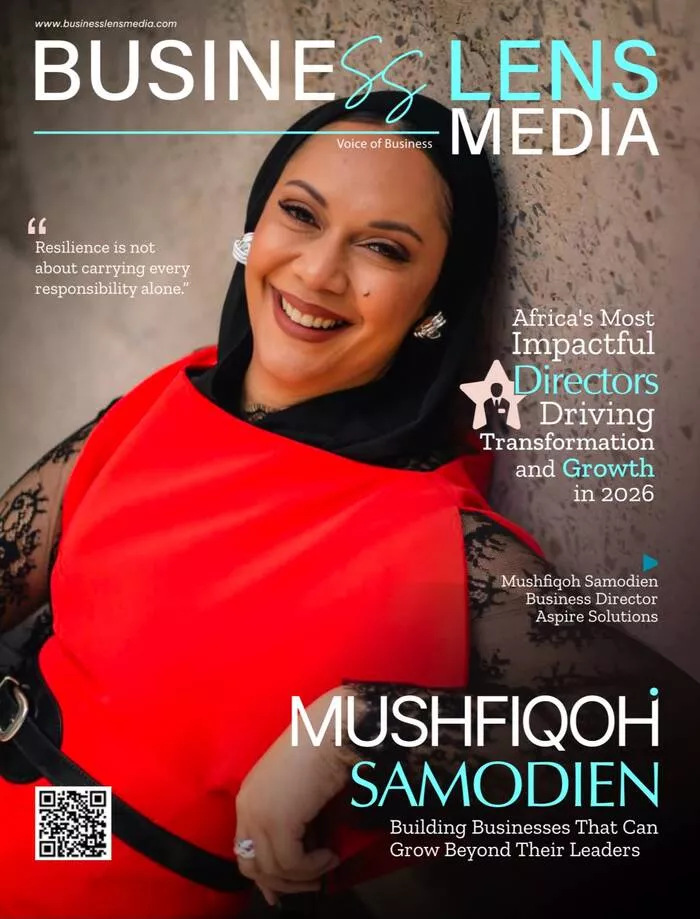
How Aspire Solutions’ Business Director is bringing together technology, human-centred leadership and responsible innovation to create lasting organisational impact.
For Mushfiqoh Samodien, business transformation begins with a question: What will remain stronger after the change has taken place? That extends beyond technology. The answer, she believes, lies in the people, relationships and capabilities an organisation develops along the way. As Business Director and co-owner of Aspire Solutions, she has spent more than 14 years contributing to a business operating at the intersection of technology, engineering and public sector transformation. Her focus today extends beyond operational delivery and commercial growth to building an organisation capable of sustaining its success through changing circumstances and future leadership.
With more than 22 years of professional experience across corporate and entrepreneurial environments, including finance, oil and gas, fast-moving consumer goods (FMCG) and technology, Mushfiqoh brings a broad commercial perspective to business leadership. Her career has not followed a conventional trajectory, but its diversity has informed a consistent principle: technical expertise becomes valuable when it is connected to business realities, people’s needs and a clear sense of purpose.
That principle is particularly relevant in an era when organisations face pressure to adopt new technologies while maintaining performance, managing risk and preparing their people for change. For Mushfiqoh, meaningful transformation is not measured by the systems an organisation implements or the speed at which it grows. It is measured by the value it creates and its ability to sustain that value over time.
Beyond the Technology: Understanding What Makes Businesses Work
Mushfiqoh’s professional experience across different industries has shaped her understanding of how organisations function and evolve. Moving between corporate and entrepreneurial settings exposed her to different commercial priorities, operating environments and approaches to decision-making. Over time, she came to recognise that business success depends on more than the quality of a technical solution.
It requires strategic judgement, commercial awareness, strong relationships and people who understand the purpose behind their work.
Her experience at Aspire Solutions has reinforced this perspective. Working across technology, engineering and public sector transformation has meant navigating environments where solutions must respond to operational demands, regulatory requirements and the needs of diverse stakeholders. The challenge is not simply to implement a system, but to ensure that it addresses the right problem and remains useful as circumstances change.
This understanding has also influenced her approach to leadership. Rather than treating empathy and collaboration as secondary to performance, Mushfiqoh sees them as essential to better decisions and stronger organisational outcomes.
“As a woman in technology, I have learned that leadership does not require us to conform to traditional expectations,” she explains. “Empathy, listening and collaboration are not softer alternatives to leadership; they are powerful capabilities that strengthen decision-making and organisational performance.”
The distinction matters. In complex business environments, leaders rarely possess every piece of information needed to make the right decision independently. Their effectiveness depends partly on their ability to recognise expertise, invite different perspectives and create the conditions in which people can contribute meaningfully.
For Mushfiqoh, leadership has therefore evolved from delivering successful outcomes to understanding how those outcomes create lasting value. The emphasis has shifted from what can be accomplished in the immediate term to what an organisation becomes capable of achieving afterwards.
Balancing Today’s Commitments with Tomorrow’s Resilience
As Business Director and co-owner, Mushfiqoh operates at the intersection of immediate business requirements and long-term organisational priorities. Client expectations, operational delivery and commercial sustainability must remain aligned, even when their demands compete for attention.
Her approach rests on three connected priorities:
- Delivering meaningful client outcomes
- Developing people’s capabilities
- Protecting the long-term sustainability of the business.
At Aspire Solutions, this means looking beyond whether a technology implementation has been completed successfully. The solution must also respond to the client’s operational realities, remain adaptable and provide value beyond its initial deployment. In environments shaped by regulation and public accountability, sustainability requires particular attention to how technology is governed, maintained and integrated into existing capabilities.
One principle distinguishes Aspire’s approach: clients retain ownership of their technology. This supports relationships based on transparency, trust and value rather than dependency. It also reflects a broader view of what successful technology partnerships should accomplish. Clients should be better equipped to use and develop their capabilities, rather than becoming permanently reliant on an external provider.
The same principle informs Mushfiqoh’s thinking about Aspire’s internal development. As a co-owner, she is increasingly focused on ensuring that the organisation’s success does not depend on a single individual, including herself.
This requires deliberate investment in leadership development, knowledge sharing and succession planning. It also demands a willingness to distribute responsibility and prepare others to make decisions.
Such work may be less visible than winning business or completing a major implementation, but it is fundamental to continuity. An organisation that depends too heavily on a few individuals carries vulnerabilities that can become apparent during growth, uncertainty or leadership transition.
For Mushfiqoh, sustainable growth means building the structures and collective capabilities that allow Aspire to evolve without losing the values and relationships that have shaped it.
Transformation Is a Human Challenge First
Technology programmes are frequently approached as exercises in systems, processes and implementation. Mushfiqoh’s experience has led her to a different starting point: understanding the people who must work with the change.
Sophisticated systems and detailed implementation plans cannot, by themselves, guarantee successful transformation. People need to understand why a change is necessary, how it affects their work and what their contributions mean to the outcome.
Her approach begins with listening. Different stakeholders bring different expectations, concerns and experiences to a transformation programme. Understanding these perspectives before attempting to drive change helps leaders identify issues that a purely technical assessment might overlook.
Communication then provides direction. People need clarity about what is changing, what will remain constant and where accountability sits.
At Aspire Solutions, collaboration between technical teams, operational stakeholders and clients has been important to navigating complex transformation programmes. Each group contributes knowledge that strengthens the overall solution. Bringing these perspectives together does not mean that every decision must be made collectively. Rather, it means ensuring that decisions are informed by the people best placed to understand their implications.
Mushfiqoh also recognises the importance of acknowledging uncertainty. Leaders do not strengthen trust by pretending to have every answer. They strengthen it by communicating honestly, explaining their reasoning and remaining accountable for decisions.
“Clarity creates direction, trust builds confidence and collaboration provides the momentum needed to turn change into sustainable progress,” she says.
This philosophy places responsibility on leaders to create environments where people can question assumptions and contribute without losing sight of the organisation’s objectives. Transformation becomes more sustainable when individuals understand both the destination and their role in reaching it.
The Lessons Behind Difficult Decisions
For Mushfiqoh, the responsibilities of business ownership have added another dimension to decision-making. Choices affect more than financial performance. They influence employees, their families, clients and the organisation’s future.
These consequences become particularly significant during periods of uncertainty, expansion and leadership transition. Decisions must account for immediate requirements while considering their longer-term effects on people and the business.
Her experience as a woman in traditionally male-dominated environments has also shaped her understanding of professional authority. Establishing credibility can require persistence, but she believes competence, integrity and consistency ultimately provide a stronger foundation than attempting to conform to established expectations.
Perhaps the more consequential shift, however, has been in how she defines resilience.
Earlier in her career, Mushfiqoh associated strong leadership with having the answers and accepting responsibility for everything. Experience has taught her that this approach has limitations. Leaders must know when to listen, when to challenge prevailing assumptions, when to make difficult decisions and when to give others the space to take ownership.
Resilience, in this context, is not about carrying every burden independently. It is about developing the judgement and relationships needed to navigate challenges without weakening the organisation around you.
That understanding has changed how she evaluates leadership. Avoiding difficult moments is not the measure of success. The quality of decisions, the relationships preserved through change and the capabilities developed in the process matter far more.
It is an approach grounded in accountability rather than invulnerability, and one that recognises that lasting organisational strength often emerges from the way people respond to uncertainty together.
Innovation With Purpose and Accountability
As artificial intelligence, automation, data analytics and digital platforms continue to expand the possibilities available to businesses, Mushfiqoh sees a growing need for disciplined technology decisions.
Her concern is not with innovation itself, but with the assumption that adopting the newest technology necessarily creates value. Organisations can invest in sophisticated solutions without addressing the underlying business problem or preparing their people to use them effectively.
Her starting point is therefore practical: what is the organisation trying to achieve, who will benefit, what capabilities are required and how will success be measured?
Experience in public sector environments has reinforced the importance of aligning technology with governance, legislation, operational capacity and financial sustainability. These considerations shape whether a solution can be adopted responsibly and maintained over time.
Continuous learning and collaboration are equally important. The pace of technological development makes it difficult for any individual or organisation to possess every capability required. Partnerships with specialists across disciplines can help close those gaps and improve the quality of decisions.
Mushfiqoh is particularly interested in technologies that improve access, strengthen decision-making and create opportunities for greater efficiency. Yet she believes their impact must be assessed in human and organisational terms, rather than through technical sophistication alone.
This perspective is informing her expanding focus as a Chief Innovation Officer, bringing software development together with cybersecurity and Governance, Risk and Compliance (GRC). These disciplines are connected by a common concern: helping organisations innovate while strengthening the controls, risk management and decision-making needed to support that innovation.
For businesses of different sizes, integrating these capabilities can support more considered growth. Governance establishes boundaries and accountability, cybersecurity addresses the protection of systems and information, and software development provides the means to create practical solutions. Their effectiveness depends on how well they work together.
Mushfiqoh’s interest lies in making these capabilities useful in practice, so that risk management and compliance become part of how organisations operate rather than isolated exercises.
Recognition, Reflection and the Responsibility to Give Back
Mushfiqoh’s professional milestones offer another perspective on the evolution of her leadership. Her recognition includes the Standard Bank Top Woman in Tech Award in 2020, the Panache Woman of Wonder Trailblazer recognition in 2021 and Inspiring 50 recognition in 2021. In 2025, she received the FAB Woman Award for Resilience and the CEO Achievement Alley Business Leadership Award, was named among the 50 Under 50 Global Future Female Founders and was recognised as a Warrior Woman Finalist.
She also completed postgraduate studies at the University of Cape Town Graduate School of Business in 2025. For her, continued education is part of the responsibility of leadership: remaining willing to question existing assumptions, acquire new perspectives and develop the judgement required for changing business environments.
Yet she does not define achievement through recognition alone. Contributing to Aspire Solutions’ growth and working alongside her business partner and team to strengthen the organisation’s capabilities and relationships remain among her most meaningful professional experiences.
She believes, “Recognition becomes more valuable when it acknowledges collective effort and creates opportunities to encourage others.”
That outlook extends into her work in youth development. Through MiniBoss, her latest venture, she is supporting the development of entrepreneurial thinking among young people aged 10 to 17. The initiative reflects her interest in helping the next generation develop business awareness and the confidence to explore entrepreneurship early.
Her debut book, scheduled for launch on 21 November 2026, offers another avenue for sharing her experiences and lessons beyond her immediate professional circles. Writing has allowed her to reflect on the decisions, challenges and relationships that have shaped her development.
Together, these pursuits point towards a broader understanding of impact. Professional success creates a platform, but its longer-term value lies in what it enables others to learn, build and pursue.
Making Leadership Sustainable
Balancing business leadership, advisory responsibilities and family life has also influenced Mushfiqoh’s understanding of sustainable performance.
As a business owner, advisor, wife and mother, she manages responsibilities that demand different forms of attention and emotional investment. She does not view balance as a permanent state in which every responsibility receives equal time. Instead, it requires deliberate choices about where attention is most needed and what should not be repeatedly sacrificed to immediate demands.
Family provides perspective, while physical activity helps her maintain the energy and clarity required for demanding work. Reflection creates space to step away from operational pressures and consider whether existing approaches remain appropriate.
Equally important has been learning to delegate and develop strong teams. If an organisation’s effectiveness depends on one person absorbing every challenge, neither its leadership nor its operating model is sustainable.
This principle extends to the advice Mushfiqoh offers other leaders, particularly women navigating expectations across professional and personal life. Seeking support should not be mistaken for a lack of capability. Recognising limits and allowing others to contribute are essential leadership skills.
Her perspective is consistent with her wider organisational philosophy: sustainability requires systems, relationships and shared responsibility, whether the goal is maintaining a business, leading a team or managing competing personal commitments.
Building Beyond the Individual
As Mushfiqoh looks towards the next phase of her career, her priorities reflect a widening definition of leadership impact. Supporting Aspire Solutions’ continued growth remains central, alongside strengthening its organisational structures, developing future leaders and preparing the business for long-term sustainability.
Her work in innovation, cybersecurity and GRC will continue to focus on bringing technical, security and business expertise together. Through strategic collaboration, advisory work and leadership development, she also hopes to expand her contribution to entrepreneurship, particularly among women and young people.
Her involvement with MiniBoss and her forthcoming book represent different ways of extending knowledge and opportunity beyond the boundaries of a single organisation. Continued education remains part of that commitment, reflecting her belief that leaders must keep evolving if they expect the organisations around them to do the same.
For emerging leaders, her advice is straightforward: remain curious, build meaningful relationships and recognise the value of collaboration. Technical knowledge and commercial understanding matter, but leadership also requires the ability to connect people, ideas and opportunities around a shared purpose.
She encourages women entering leadership to recognise that authenticity and empathy can coexist with authority, ambition and decisive action. Taking risks, learning from failure, seeking mentors and creating opportunities for others are all part of developing that capacity.
Ultimately, Mushfiqoh’s approach returns to a principle that has shaped her decisions at Aspire Solutions and beyond: success becomes more meaningful when it is shared. The measure of a leader is not simply the organisation built or the recognition received, but the strength, confidence and capability others gain through working alongside them.
In a business environment where transformation is often judged by immediate results, her perspective offers a longer view. Lasting impact requires more than delivering change. It requires building organisations that can continue to adapt, people who are prepared to lead and an environment in which future success does not depend on one individual.
That is the distinction between achieving growth and preparing an organisation to sustain it. For Mushfiqoh Samodien, the real work of leadership lies in making that future possible.