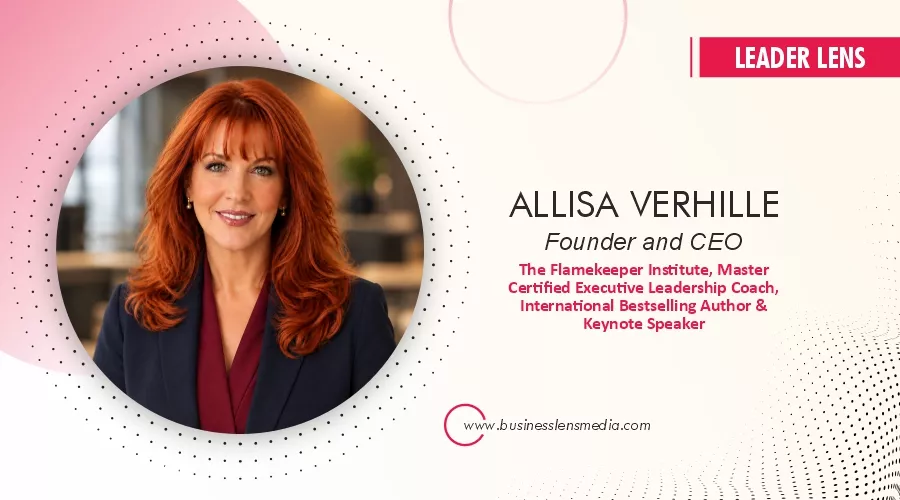
In an era when high performance is increasingly measured by speed, scale and results, Allisa Verhille brings a different question to the leadership conversation: What does success demand from the person achieving it?
As CEO of The Flamekeeper Institute, LLC, a Master Certified Executive Leadership Coach, keynote and motivational speaker, and author of The Fire Within™ Series, Allisa works with executives, founders and leadership teams navigating consequential moments of growth, transition and transformation. Her approach brings together decades of executive experience across technology, transformation, governance and high-pressure initiatives with a deeply personal understanding of resilience, identity and reinvention.
Through The Flamekeeper Institute, Allisa brings together proprietary frameworks, executive advisory, Leadership Intensives and organizational transformation to help leaders and organizations examine not only what they want to accomplish next, but what must change to carry that success sustainably. Her work reflects a broader perspective on modern leadership: exceptional performance should not require people to lose themselves in the process.
Leadership Before the Title
For Allisa Verhille, leadership began long before the executive roles, transformation work, speaking engagements and leadership credentials that would later shape her career. It began on an 80-acre farm, where her grandparents impressed upon her two principles that have remained remarkably durable: a person’s name is a reputation, and a word is a bond.
At fourteen, Allisa was diagnosed with cancer. A year later, surgery removed part of the top of her left foot. Her recovery required her to learn to walk again, then gradually jog, run, and jump before eventually returning to basketball. That experience became foundational to her understanding of resilience: not simply returning to who she had been, but discovering who she could become.
“Resilience isn’t pretending something doesn’t hurt or putting on a brave face and pushing harder,” she says. “Sometimes resilience is simply deciding, This will not be the end of my story.”
That distinction matters. After decades spent leading technology, transformation, governance, PMOs and high-pressure initiatives, Allisa saw another form of resilience being demanded from high performers: the ability to keep delivering while becoming increasingly depleted. Capable executives were producing exceptional results while becoming trapped inside the identities and habits that had helped them succeed.
The question that emerged now sits beneath much of her work: What is all this performance costing you and who are you becoming while producing it?
For Allisa, high-performance leadership is therefore not simply a question of output. It is a question of identity, sustainability and choice.
Where Performance Meets the Person
As Founder and CEO of The Flamekeeper Institute, LLC and a Master Certified Executive Leadership Coach, Allisa works at what she describes as critical inflection points, where people, leadership, strategy and organizational performance need to change together.
These moments can take many forms. An executive may be questioning whether the next promotion is actually the next chapter they want. A founder may realize that a growing business has become an organization whose people depend on them to lead differently. A leadership team may know that something is not working without yet understanding what needs to change.
Rather than treating these situations as isolated coaching problems, Allisa approaches them as interconnected leadership challenges. Her working sequence is straightforward: “See clearly. Decide deliberately. Build intentionally. Implement courageously.”
That emphasis on implementation distinguishes her approach. The Flamekeeper Institute is a leadership transformation and organizational performance institute, not simply a place to purchase coaching hours or receive advice from the sidelines. Its work brings together executive advisory, leadership development, organizational thinking and implementation, with the aim of creating tangible change after the conversation ends.
The underlying principle is simple: if nothing is different once the engagement is over, a useful conversation may have happened, but leadership has not necessarily transformed.
The Cost of Performing Without Alignment
Allisa challenges a familiar assumption in executive culture: that endurance is evidence of leadership.
High performers can become exceptionally skilled at functioning while depleted. They lead meetings, make decisions, reassure teams, hit targets and repeat the cycle. Because the results continue to arrive, the strain can remain invisible to colleagues and sometimes even to the leader themselves.
Her alternative is sustainable high performance, which begins with alignment. Values need to align with decisions. Ambition needs to align with the life being created. Boundaries need to align with the energy required to lead effectively. Most importantly, identity needs to become larger than a title or organizational role.
This does not mean lowering ambition. Allisa describes herself as deeply ambitious and says she enjoys working with ambitious people and seeing them accomplish what once seemed impossible. The distinction is in what success is allowed to cost.
“I simply don’t believe success should require someone to disappear inside it,” she says.
That philosophy becomes more developed through The Flame Spiral™, Allisa’s proprietary framework for understanding transformation.
A Spiral Rather Than a Straight Line
The Flame Spiral™ emerged from Allisa’s observation that meaningful transformation rarely follows a neat sequence. People revisit courage and resilience. They reinvent themselves. They reach new thresholds and discover that something they believed they had already mastered is asking something different of them. The framework moves through five phases: Ignition, Empowerment, Resilience, Courage and Legacy, with the same five movements repeating within every phase: Remember, Release, Reclaim, Rise and Illuminate.
Its twelve interconnected elements Ignition, Empowerment, Resilience, Courage, Transformation, Leadership, Alignment, Reinvention, Wisdom, Legacy, Connection and Eternal Impact map transformation as an ongoing process rather than a one-time breakthrough.
At the center is a particularly consequential idea: performance is downstream from identity.
When who a person is, what they value and how they live become disconnected, performance can become increasingly expensive. Resilience, in this framework, is also more than bouncing back. Sometimes the lesson of a difficult experience is not to return to an earlier version of oneself, but to become someone different.
That leads to a more demanding leadership question: “Who must I become to carry that success without losing myself inside it?”
It is a question that extends beyond individual executives. It also applies to organizations, founders and teams navigating moments when previous methods are no longer sufficient.
From Advice to Applied Transformation
The executive coaching and leadership development market is crowded. Information is abundant, and artificial intelligence can generate advice almost instantly. Allisa sees that environment less as a threat than as a reason to make the work more useful.
The Flamekeeper Institute’s Leadership Intensives illustrate that philosophy. The process begins with diagnosis rather than prescription. Allisa and her team examine the leader, team, priorities, strengths, vulnerabilities, accountability, decision-making, communication and the conditions surrounding performance.
The questions are deliberately practical:
- What are people working around instead of fixing?
- Where is leadership friction slowing execution?
- Where are strengths being underused?
- What problem keeps returning in a different form?
From there, the work identifies high-leverage priorities, defines success, establishes ownership, agrees on measurable outcomes and develops an implementation plan. The Institute remains involved beyond the initial discussion.
For Allisa, that distinction is critical. A workshop that inspires people for a day but produces no change afterward has limited value. The objective is not simply recognition of a problem. It is movement.
Listening Beneath the Stated Problem
Allisa’s approach to emerging leadership needs is rooted in listening for what sits beneath the stated issue.
An executive asking for “executive presence,” for example, may actually be questioning whether they trust their own voice. An organization describing a “communication problem” may be experiencing symptoms of unclear accountability, conflicting priorities or decisions that no one truly owns.
The same principle shapes her Career Ascension Program. When accomplished executives say they are ready for their next role, Allisa does not begin with a résumé. She begins with the individual.
What should this chapter provide that the last one did not? What still creates energy? Which strengths remain underused? What is no longer worth sacrificing? What environment allows the person to lead at their best? And what does success mean now?
Only after those questions are answered does career strategy, positioning and transition become useful.
The objective is not to help someone become exceptionally good at winning a job they may eventually wish they had never taken.
Building an Independent Voice
Allisa has built credibility across executive leadership, organizational transformation, advisory work, publishing, and speaking, including engagements at Oxford and Columbia. Her forthcoming six-volume The Fire Within™ book series, scheduled to begin publication in early 2027, explores identity, resilience, transformation and legacy, while her speaking brings these ideas to broader audiences.
Yet she is cautious about equating visibility with authority.
Credentials, prominent institutions and published work can establish credibility, she argues, but authority develops when experience, ideas, application and results reinforce one another. Her corporate career showed her how organizations behave under pressure. Her work with leaders exposed her to conversations that rarely reach the boardroom. Her personal history gave her an intimate understanding of resilience. Writing required her to put language around what she believes, while speaking taught her that an idea becomes meaningful when another person recognizes themselves in it.
Whether addressing executives, entrepreneurs, emerging leaders or broader audiences, she looks for that moment of recognition.
She wants people to laugh, think and occasionally feel uncomfortable, because meaningful change can begin with an uncomfortable truth.
“Motivation can ignite something,” she says. “But ignition alone isn’t enough.”
The work after the spark is where frameworks, advisory work and organizational transformation become important.
Stewardship Over Perfect Balance
Running an institute while advising leaders and organizations, speaking, writing and developing intellectual property requires another form of leadership: deciding what deserves attention.
Allisa no longer pursues the idea of perfect balance. Leadership, she believes, has seasons. There are periods when writing needs more attention, others when clients, speaking engagements, or building the Institute take priority.
Her more useful question is one of stewardship: “Does this deserve access to me?”
That question has helped her turn away from opportunities that appeared impressive but were not aligned with the mission. Every yes, she notes, creates an invisible no somewhere else.
For a leader whose work centers on sustainable performance, the principle is also an example of the practice. Protecting the quality of the work sometimes means disappointing an opportunity rather than disappointing the mission or oneself.
A Larger Mandate for the Institute
Allisa’s ambition for The Flamekeeper Institute is larger than building a successful coaching practice. She is building an institution designed for the moments when leaders and organizations face consequential choices when the person, the leadership and the organization can no longer grow separately.
A leader asks where to go next. A founder asks how to build the company correctly. A leadership team asks why it is not operating at the level it knows is possible. An organization asks what must change to reach its next destination.
These are the conversations Allisa wants the Institute called into.
Entrepreneurs are a particular focus. Founders often devote enormous energy to building the business, but growth eventually requires them to build an organization capable of carrying that business. That means developing culture, defining how people work together, hiring and developing talent, creating accountability and strategy, and evolving the founder alongside the company.
The Institute’s Leadership Intensives, executive leadership and advisory work, organizational transformation, Executive Career Ascension, founder advisory, speaking, publishing and executive education are therefore different expressions of a common purpose: helping people and organizations see what needs to be built, strengthened or transformed, then helping them make it real.
The longer-term vision includes proprietary frameworks, executive education, organizational transformation, founder advisory, research, publishing, speaking and strategic partnerships.
Not because the goal is to do everything, but because the aim is to become exceptionally good at one thing: helping people and the organizations they lead move through consequential change without losing sight of what matters most.
The Human Being Behind the Performance
That philosophy becomes especially relevant as technology reshapes leadership itself. Allisa expects artificial intelligence to become more capable, technology to accelerate and organizations to change faster. Some work traditionally performed by people will inevitably be done differently.
But she does not see that as making human leadership less important. In her view, it makes it more important.
Leaders will still need judgment when answers are unclear, courage when decisions are unpopular, trust when uncertainty is high, discernment when information is abundant and meaning when change becomes relentless. They will need to stand inside uncertainty without transferring all of it onto the people around them.
That is the future of leadership Allisa is interested in helping build.
Her advice to emerging and established leaders begins with a deceptively simple change in language. Instead of asking only, “What’s next?” she encourages them to ask, “What’s mine?”
The distinction separates external expectations from internal conviction. It asks leaders to examine not only the promotion, company or career they could pursue, but the life and identity they are choosing in the process.
She believes leaders should know what they value before pressure tests those values, what they will not trade for achievement, who they are when the title disappears and what kind of experience others have when they enter the room.
Reinvention, in this view, does not mean the life built previously was wrong. It may simply mean the person who built it has outgrown that version of themselves.
For Allisa, that is ultimately the deeper purpose of high-performance leadership: not performing harder, but becoming capable of carrying greater responsibility, change and impact without abandoning the humanity that makes leadership matter.
“The most important leadership technology we will ever develop is still the human being.”
To explore executive advisory, Leadership Intensives, founder advisory and organizational transformation, visit www.theflamekeeperinstitute.com