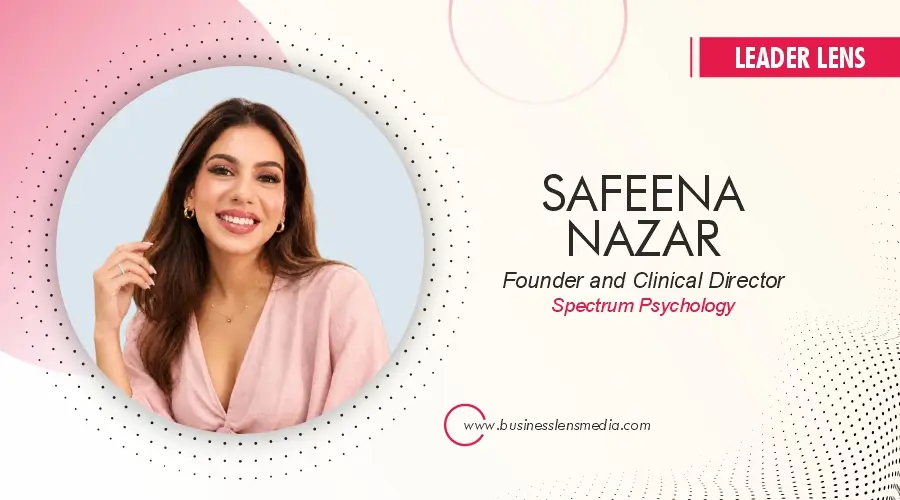
For Safeena Nazar, clinical psychology is both a professional calling and a deeply personal journey. As Founder and Clinical Director of Spectrum Psychology in Nairobi, she brings together clinical practice, research and organisational leadership, guided by an understanding of what it means to struggle without knowing why.
Her clinical interests span ADHD, autism, emotional regulation, trauma and developmental needs. She is particularly attentive to people whose difficulties have been mistaken for laziness, poor motivation or difficult behaviour, often leaving them questioning their abilities rather than understanding their needs.
Safeena knows this experience firsthand. She grew up struggling with ADHD, dyscalculia, anxiety, rejection sensitivity and depressive episodes. After her father died when she was nine, her difficulties became more apparent, although her learning and attention challenges remained unrecognised. Grief and trauma were part of her experience, but they did not explain everything.
She remembers being told she was lazy or not applying herself and being compared with friends who performed better academically. She knew she was trying, yet could not understand why her effort did not produce the results others expected. The criticism affected her confidence and shaped how she saw herself.
At twenty, while studying early childhood education and special needs, she learned about ADHD, recognised aspects of her experience and sought an assessment. The diagnosis changed the direction of her life. Her grades improved; she maintained a consistently high GPA and graduated on the honour roll.
The discovery brought relief, but also grief for the years she had spent feeling misunderstood and for the effect those experiences had on her confidence and relationships.
“Understanding how my mind worked changed what I believed was possible for myself,” she reflects in her original interview response.
That experience continues to influence her work. She understands how much a timely explanation can change a person’s understanding of themselves, and how damaging it can be when difficulties remain misunderstood. Her clinical education and training help her turn that personal understanding into considered, evidence-based care.
From Personal Understanding to Clinical Purpose
Safeena’s education has progressed from early childhood education and special needs to psychology, social, emotional and behavioural difficulties, and clinical psychology. She completed her Master’s in Clinical Psychology at the University of Manchester and is pursuing a PhD focused on ADHD and neurodevelopmental disorders.
Her education in Canada, professional experience in Zambia and current work in Kenya have also shaped her perspective. Across these settings, she has seen how a person’s circumstances, available resources and relationships influence the support they can receive.
A central principle guides her clinical work: understanding a person’s difficulties requires looking beyond the first explanation.
A child struggling at school may be making considerable effort despite attention or learning challenges. An adolescent may find it difficult to express emotional distress. An adult may appear professionally successful while struggling privately with organisation, anxiety or the demands of everyday life.
Safeena draws on clinical interviews, developmental history, observations and appropriate standardised measures to build a fuller picture. Where relevant and with consent, she considers information from parents, teachers and other professionals. Differences between accounts can offer important clues about the environments in which a person struggles and the support they already receive.
She is equally conscious of the cultural and practical context surrounding each client. Family expectations, educational environments, community attitudes and access to services can all influence how psychological difficulties are understood. These factors matter when interpreting findings and deciding what support is realistic.
At Spectrum Psychology, this approach informs psychological and neuropsychological assessments, support for ADHD- and autism-related presentations, anxiety, emotional regulation, trauma-informed care, EMDR, couples therapy and family support.
Her therapeutic work draws on established approaches, including Cognitive Behavioural Therapy (CBT), Dialectical Behaviour Therapy (DBT), Acceptance and Commitment Therapy (ACT), exposure and response prevention, solution-focused therapy, emotionally focused therapy, Gottman-informed work and play-based approaches.
Her continuing professional development includes EMDR training and TMS clinical certification.
For Safeena, an assessment or intervention should leave a person with a clearer understanding of their experience and a meaningful way forward. That requires clinical evidence, careful judgement and attention to whether the work is helping with the concerns that matter to the client.
Building Spectrum Psychology and Its Team
As Founder and Clinical Director, Safeena balances direct clinical work with the responsibility of developing a growing practice. She is clear about which part of her profession she loves most: working with clients, understanding their experiences and helping them navigate difficulties.
Her leadership has grown from that commitment. She provides clinical direction, consults on complex presentations and supports team members in developing confidence in their own clinical judgement. She wants each professional to contribute their expertise while feeling supported and taking appropriate ownership of their work.
Safeena also describes herself as a Type A personality, with a clear and specific way of working. She has a long-term vision for Spectrum and is determined to bring it to life. Maintaining clinical standards, communication and consistency across the practice matters to her, particularly as families may work with different members of the team.
At the same time, she recognises that leadership is not about making every decision herself. Delegation, consultation and reliable systems allow the team to share responsibility and help protect the quality of care. She is learning to communicate her vision clearly while making room for other professionals to contribute their own strengths and judgement.
Her ambition is to build a practice in which the team’s development strengthens the care clients receive. Clinical expertise matters, but so does creating an environment where professionals can keep learning, discuss difficult cases and work together effectively.
This vision has also been shaped by her experience in Zambia. There, mental health and school-based interventions were almost nonexistent in the settings where she worked. Referral pathways were limited and multidisciplinary support was difficult to access.
She had to consider what could realistically be achieved with the resources available. Recommending a service meant little if a family could not access it or if the professionals needed to provide further support were unavailable.
That experience reinforced her belief in the importance of professional relationships and coordinated care. It continues to inform her ambition to build the clinical expertise and referral networks that help people access appropriate support.
Research, Curiosity and Continued Learning
Safeena’s interest in ADHD and neurodevelopmental disorders extends beyond her clinical responsibilities. She describes neurodivergence as one of her enduring hyperfixations, a subject that engages her personally as well as professionally.
Her ongoing PhD research explores ADHD and neurodevelopmental disorders. She is particularly interested in why someone may know what needs to be done yet struggle to begin, organise or follow through, and how neurodevelopmental needs interact with trauma, emotional experiences and environmental demands.
These questions connect her research with the concerns she encounters in clinical practice. They also reflect her own experience of having difficulties that were not fully understood for years.
Safeena’s approach to professional development is grounded in curiosity. When a person’s experiences do not fit neatly with an initial explanation, she wants to understand what might be missing. Reading, further training and supervision help her examine complex cases, challenge assumptions and refine her clinical reasoning.
Her professional learning spans neurodevelopmental assessment, trauma, anxiety, emotional regulation, relationships and child development. She approaches new developments with enthusiasm, while relying on research, training and supervision to evaluate the evidence.
For her, continuing to learn is part of the responsibility of clinical practice. The aim is not simply to acquire more knowledge, but to use it to make better-informed decisions and provide more useful support.
The People Behind the Professional
For all her professional ambitions, Safeena identifies her children as her greatest motivation. Motherhood has deepened her understanding of the responsibility, uncertainty and love that parents bring into clinical conversations. It also gives her a personal reason to keep building a practice she believes can make a meaningful difference.
Her mother remains central to her story. After Safeena’s father died, she raised her as a single parent and supported her through years in which her learning and attention difficulties were not fully understood. Making her mother proud while she is here to witness her achievements means an enormous amount to Safeena.
Graduating on the honour roll remains particularly significant. It marked a turning point after years of doubting her academic abilities, helping her rebuild confidence that had been worn down by misunderstanding and comparison.
These experiences inform how she sees the people who come to her for support. She knows that a person’s difficulties can become entangled with their sense of identity, particularly when they have spent years believing they are not trying hard enough. She wants clients to have the opportunity to understand their experiences without defining themselves by the labels they have received.
Her personal life also reminds her that professional expertise does not remove ordinary human challenges.
Alongside her work at Spectrum, Safeena serves as a Board Member of the Aga Khan Health Board Kenya. She describes the role as an act of service to her community and values the opportunity to learn from a strong team and contribute beyond her own practice.
Maintaining balance across clinical work, leadership, community service and family life remains a work in progress. Safeena can become deeply absorbed in projects, and her determination to build Spectrum means she has to be deliberate about when to pause.
She relies on clear working hours, delegation and realistic scheduling, while acknowledging that her ADHD sometimes has rather ambitious ideas about what can fit into one day. She is learning to plan around her actual capacity rather than what she wishes she could accomplish.
Rest, emotional processing and seeking support matter to her, too. Being a psychologist does not make her immune to difficult periods or mean she always has everything figured out.
Her children remain central to how she defines balance. She wants to continue doing work she loves while being present for their everyday lives. For her, sustainable leadership means recognising personal limits and building systems that allow the practice to grow without depending entirely on her individual effort.
A Wider Vision for Mental Healthcare in Africa
Safeena has a clear vision for Spectrum Psychology, although she jokes that her ADHD regularly contributes more ideas before she has finished implementing the first. Her challenge is deciding what comes next and giving each step the attention it deserves.
She wants Spectrum to be a place where people can bring difficulties they have never quite been able to explain: a child whose effort is mistaken for laziness, an adolescent struggling to communicate what is happening internally or an adult who has achieved a great deal but finds daily life exhausting.
Her ambition is to offer careful assessments, useful explanations and support that continues beyond the delivery of a report. Developing her team and strengthening professional relationships are central to that goal, as is building the referral networks she wished had been available when she worked in Zambia.
Her PhD offers another avenue for contribution. By exploring ADHD and neurodevelopmental disorders, she hopes to deepen understanding of difficulties that may otherwise be overlooked and contribute knowledge that can inform clinical practice.
A phrase someone once shared with her has stayed with her: “pressure is a privilege”. For Safeena, it captures both the opportunity to build something she cares deeply about and the responsibility of being trusted with people’s wellbeing. She is determined to see her vision for Spectrum through while learning to recognise her own limits.
Her advice to emerging mental health professionals reflects the same combination of ambition and humility. She encourages them to build strong clinical foundations, think beyond the first explanation, take supervision seriously and recognise when to ask questions or refer.
She also emphasises the importance of professional relationships and communicating findings in language people can use. As she puts it, “A beautifully written report means very little if the person reading it still does not understand themselves or know what to do next.”
Above all, she encourages emerging professionals to bring their humanity into clinical work while remembering that every client’s story belongs to them. Personal empathy can help clinicians connect with people, but it must be accompanied by sound judgement, appropriate boundaries and a willingness to keep learning.
Safeena’s wider contribution begins with the care she provides and the practice she is building. She wants her children to see that she took something painful in her own life and used it to create opportunities for others. Helping someone find understanding earlier than she did would make that work deeply worthwhile.
Clinical Expertise, Grounded in Humanity
Safeena Nazar’s work brings together clinical psychology, research and organisational leadership, shaped by a personal understanding of what it means to be misunderstood and a determination to make psychological care more thoughtful and accessible.
Through Spectrum Psychology, her ongoing research and the professionals she supports, she is working towards a model of care that takes individual experiences seriously and helps people move from uncertainty towards understanding.
Her story is not one of having every answer. It is one of continuing to ask better questions, recognising the limits of what she knows and building the relationships and expertise needed to help others.
For Safeena, that is where meaningful progress in mental healthcare begins: with taking each person’s experience seriously, remaining open to what may have been missed and helping people see possibilities they may once have thought were beyond them.