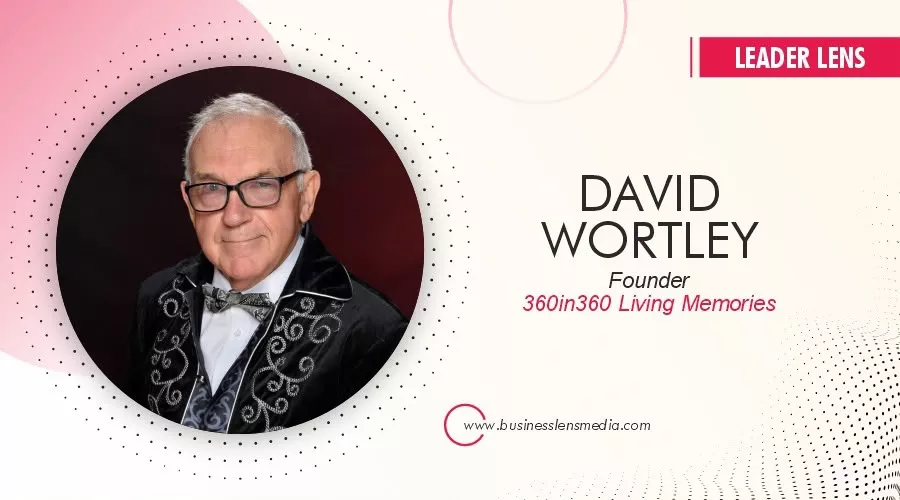
David Wortley FRSA has spent more than fifty years at the intersection of technology and human potential. A keynote speaker who has addressed audiences across six continents, he is a pioneer in wearable health technology, immersive experiences, and digital legacy — and one of the few voices in the technology space who has lived through every major revolution from the mainframe to artificial intelligence.
He is the founder of 360in360 Living Memories, author of Gadgets to God (2012), a Visiting Researcher at Bournemouth University, and a Project Supervisor at UCL’s Global Business School for Health. A Fellow of the Royal Society of Arts, his work explores a single question: how technology can help humanity live longer, healthier, more connected, and more meaningful lives.
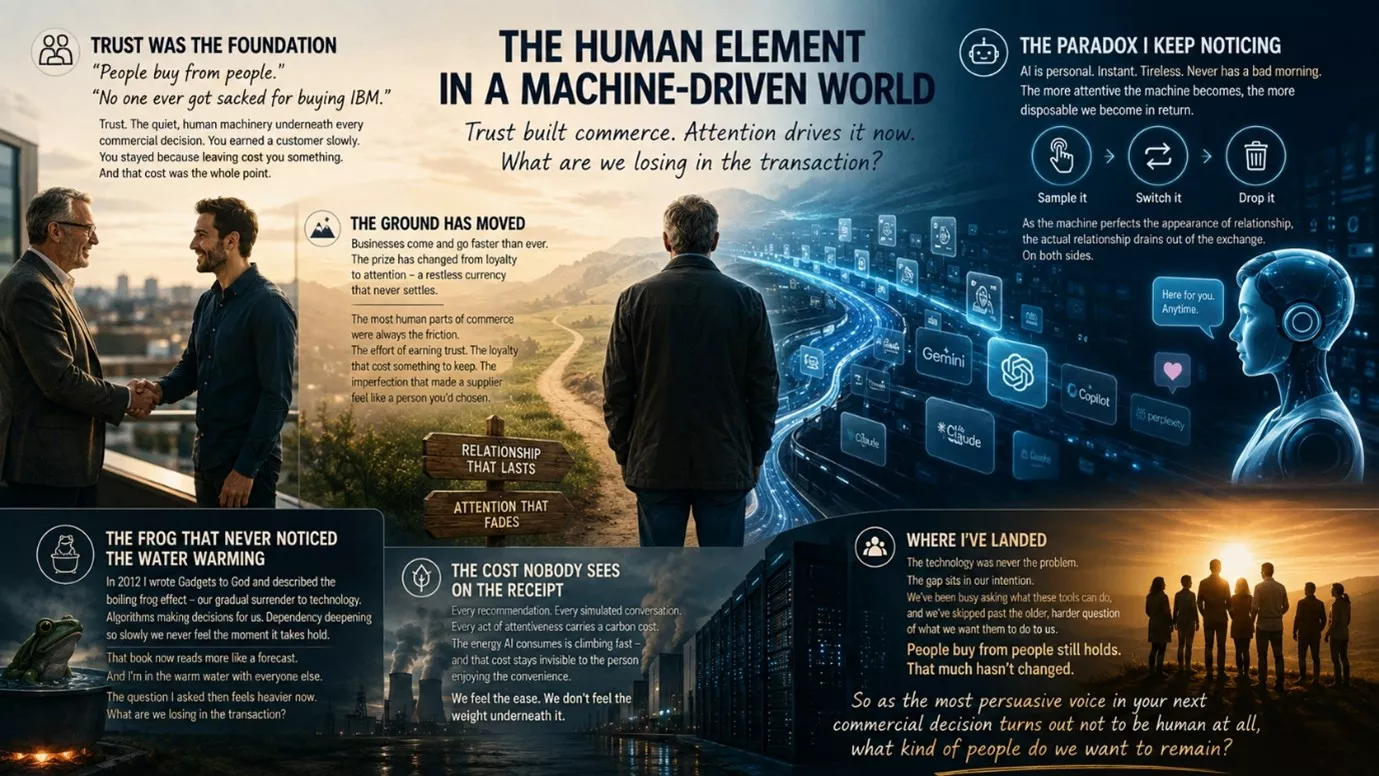
When I worked as a marketing executive at IBM, two sayings governed almost everything we did.
People buy from people.
No one ever got sacked for buying IBM.
Both were really about the same thing. Trust. The quiet, human machinery underneath every commercial decision. You earned a customer slowly. You read their doubt in their eyes. You stayed with a supplier because leaving cost you something, and that cost was the whole point. It meant the relationship was real.
The ground has moved
Businesses now arrive and disappear in shorter and shorter cycles. The thing we compete for has changed too. It used to be loyalty. Now it’s attention, and attention is a restless currency that never settles anywhere for long.
I’ve been watching technology for more than fifty years, and I keep returning to one pattern.
The most human parts of commerce were always the friction.
The effort of earning trust. The loyalty that cost something to keep. The imperfection that made a supplier feel like a person you’d chosen rather than a service you’d sampled.
The paradox I keep noticing
AI is getting very good at pretending to have a lasting relationship with you. It’s personal. It answers instantly. It never tires and it never has a bad morning.
And here’s what I find quietly striking.
The more attentive the machine becomes, the more disposable we become in return. People switch between AI platforms with no hesitation and no loyalty. We treat these near-perfect relationships as things to sample and drop.
As the machine perfects the appearance of relationship, the actual relationship drains out of the exchange. On both sides.
The frog that never noticed the water warming
In 2012 I wrote a book called Gadgets to God. In it I described what I called the boiling frog effect. Our comfortable, gradual surrender to technology, with none of us noticing quite what we were handing over. I wrote about algorithms starting to make our decisions for us, and about a dependency that would deepen so slowly we’d never feel the moment it took hold.
I’ll be honest with you. That book now reads more like a forecast than I ever wanted it to.
And I say that as a heavy user of these tools myself. I’m not standing outside this looking in. I’m in the warm water with everyone else.
The question I asked then feels heavier now. What are we losing in the transaction?
The cost nobody sees on the receipt
This isn’t only about us. The energy that AI consumes is climbing fast. Every recommendation, every simulated conversation, every tireless act of attentiveness carries a carbon cost, and that cost stays invisible to the person enjoying the convenience.
Commerce is now being driven by AI at a scale that is quietly unsustainable. We feel the ease. We don’t feel the weight underneath it.
Where I’ve landed
The technology was never the problem. It never has been.
The gap sits in our intention. We’ve been busy asking what these tools can do, and we’ve skipped past the older, harder question of what we want them to do to us.
People buy from people still holds. That much hasn’t changed.
So as the most persuasive voice in your next commercial decision turns out not to be human at all, what kind of people do we want to remain?
Website: davidwortley.com
Book: gadgets-to-god.sintra.site
LinkedIn: linkedin.com/in/david.wortley