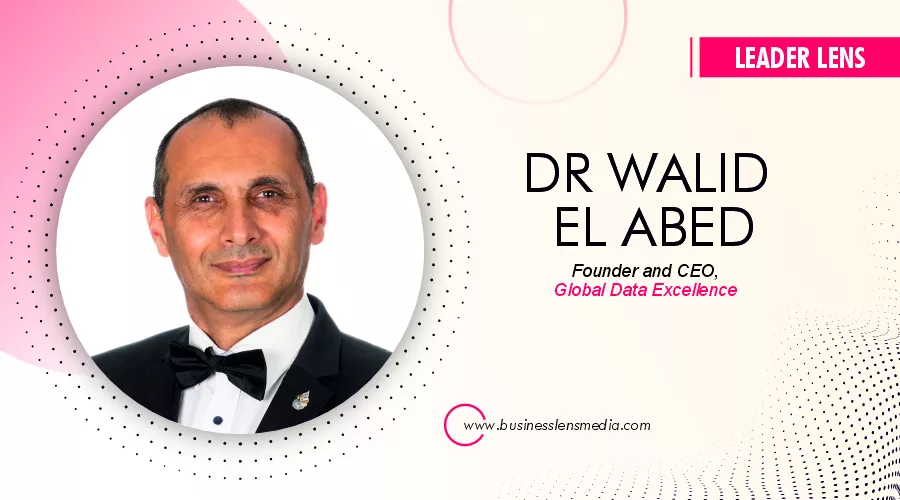
Dr Walid el Abed warns that one of the most pressing and least discussed threats in today’s AI and data governance landscape is the plagiarism and counterfeiting of proprietary scientific frameworks such as Data Excellence Science©. Developed over three decades, Data Excellence Science©, the Data Excellence Framework© (DEF), the Data Excellence Maturity Model© (DEMM), the Semantic Meta Model© (SMM), and indices like the Data Excellence Index© (DEI), Key Value Indicator© (KVI) and Key Security Indicator© (KSI) form a coherent science recognised globally in universities, corporations, and public institutions. Yet as these concepts have gained influence, they have also attracted imitators who replicate or re‑label core ideas without licence, attribution, or any real understanding of the underlying science.
For Dr el Abed, this is not a merely academic issue of credit, but a systemic risk to trust. When market offerings copy or dilute Data Excellence concepts, they often do so superficially, stripping away the rigorous semantics, value logic, and governance safeguards that make the original science reliable. Organisations may be sold “Data Excellence‑style” maturity models or look‑alike indices at a high price, only to discover that the indicators are misleading and the decisions built on them are flawed. In the age of AI‑driven, data‑driven governance, this kind of conceptual plagiarism can propagate errors at scale, undermining regulatory compliance, financial stability, and public confidence.
He sees this as part of a wider integrity crisis in the digital and AI ecosystem, where copying methods, scraping knowledge, and repackaging others’ work is too often normalised. Under Swiss law and many international frameworks, scientific models, terminologies and software‑embedded knowledge are protected works; unlicensed replication is not innovation but copyright infringement and unfair competition. More importantly, it is a breach of the ethical duty that data and AI professionals owe to citizens whose lives and rights are shaped by the systems they design.
In response, Global Data Excellence has taken a firm stance: systematically monitoring offerings and publications that appear to misuse or mimic Data Excellence Science©, and preparing, where necessary, to defend its rights through formal notices, claims for damages, and court proceedings. At the same time, Dr el Abed insists on a constructive path for those who may have incorporated these concepts in good faith. Vendors, consultants and institutions are invited to come forward proactively, clarify their use, and regularise it through licensing, certification, or partnership. For clients, regulators and partners, his message is equally clear: demand formal proof of legitimate Data Excellence certification before relying on any method or report that claims such expertise.
Ultimately, Dr Walid el Abed’s view is that the future of AI and data governance will not be decided only by new algorithms, but by whether society protects the scientific integrity of the frameworks that govern value, risk and rights. Data Excellence Science© was created to serve enterprises, institutions and citizens, not to be diluted, repackaged or exploited without respect for its authorship. Those who build on this work now face a choice he articulates bluntly: engage in good faith, align with both science and law, or be prepared to answer for the consequences of plagiarism in the courts and in the court of public trust.
Dr. Walid el Abed’s bio:
Dr Walid el Abed is the founder and CEO of Global Data Excellence, a Geneva-based company pioneering the convergence of linguistics, artificial intelligence, and ethical data governance. A French Palestino-Lebanese Swiss resident and refugee under UN protection, he holds a Ph.D. in Artificial Intelligence from the Université de Franche-Comté, where his work on the Semantic Meta Model (SMM) laid foundations for advanced natural language processing systems. He created Nixus, one of the first natural language human–computer dialogue systems, and later the Data Excellence Management System (DEMS) and Data Excellence Framework (DEF), enabling organizations worldwide to operationalize data as a strategic, ethically governed asset. A recognized thought leader, lecturer, and award-winning entrepreneur, Dr el Abed actively promotes digital human rights and fair, value-driven use of AI in both public and private sectors.