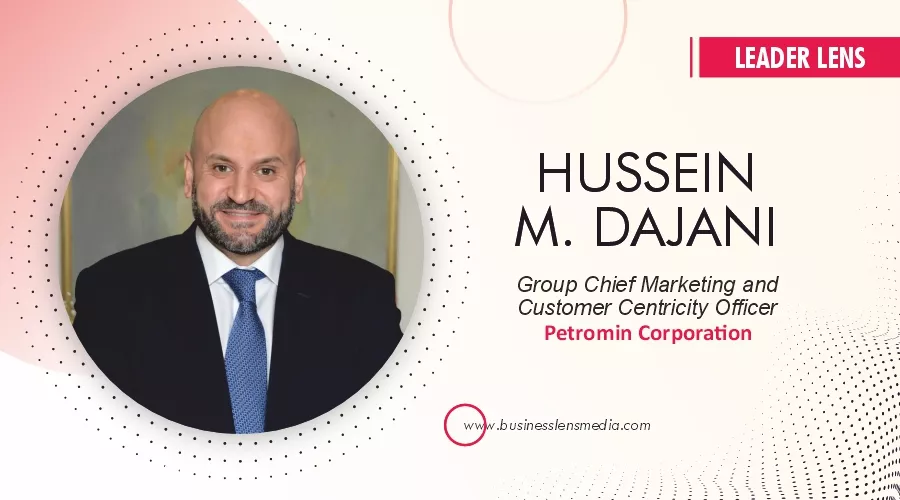
Hussein M. Dajani is a globally recognized leader in customer experience, digital transformation, and AI-enabled marketing. With over two decades of executive experience at Petromin, Deloitte Digital, Nissan, Virgin Mobile, WPP, and Publicis, he brings deep operational expertise and strategic foresight to boardrooms. He has led enterprise-wide transformations across 85+ markets, launched the MENA region’s first automotive Gen AI solution, and consistently delivered growth through customer-centric innovation. Hussein sits on the Advisory Boards of the CMO Council and CXPA, is a World AI Council Member, a Global AI Ambassador to the UAE with GAFAI and Global Council for Responsible AI, is a certified Chief AI Officer, and a Reputation Risk Advisory Council Member with the Global Situation Room, and a Reputation Capital Council Member with Earned First. He has received numerous accolades as highlighted on his LinkedIn profile below. He is fluent in Arabic, English, and French, and is based in Saudi Arabia with a global outlook. Whether leading digital revolutions or orchestrating brand relaunches, Hussein’s influence is felt across boardrooms, global stages, and the future of marketing itself. Feel free to chat with Hussein’s digital advisor: https://tinyurl.com/ask-Hussein
For years, “digital transformation” has been the headline of modern business. Covid-19 made it unavoidable. Overnight, companies had to digitize customer journeys, move operations online, and reinvent how they engaged, sold, and served. It was a defining moment and it changed business forever.
But that chapter is over.
The next transformation shaping the Gulf is not digital transformation alone. It is resilient transformation.
That distinction matters. Because what businesses are facing today is fundamentally different from what they faced during the pandemic. The challenge is no longer just how to go digital. It is how to remain effective, relevant, and trusted in a world shaped by volatility: geopolitical tension, disrupted supply chains, economic pressure, and constantly shifting customer expectations.
In this environment, efficiency is no longer enough. Speed is not enough. Even innovation on its own is not enough. What matters now is whether a business can absorb shocks, adapt quickly, and still deliver a seamless customer experience when conditions change overnight.
That is why resilience has become the new competitive advantage.
For many organizations, transformation has focused on platforms, channels, and automation. Those investments were necessary, but they were only the beginning. The next wave of transformation is about building operating models that are more adaptive, more intelligent, and more customer-aware. It is about creating businesses that can respond in real time, not after the damage is already done.
This is where AI is moving from hype to strategic necessity.
Used correctly, AI is not just a tool for productivity. It is a tool for anticipation. It helps businesses detect changes in customer behavior faster, make better decisions, personalize engagement at scale, improve service quality, and increase responsiveness across the entire value chain. In sectors such as automotive, mobility, retail, and service, the real power of AI is not that it automates tasks. It is that it strengthens resilience.
But let us be clear: buying technology alone does not create transformation.
Too many businesses still confuse activity with progress. They launch pilots, test use cases, and announce innovation agendas, but fail to embed transformation into the business itself. Real transformation happens when AI, data, customer experience, and operations work together as part of one coherent model. It happens when organizations move from isolated experiments to enterprise capability.
It also happens when they stop thinking globally by default and start thinking contextually. In the Gulf, customers do not want generic digital experiences imported from elsewhere. They expect relevance. They expect brands to understand language, culture, behavior, and local nuance. The companies that will win in this region will not be the ones with the loudest innovation story. They will be the ones that combine intelligence with empathy, scale with localization, and speed with trust.
That is why the Gulf has such a powerful opportunity right now. This region has ambition, investment appetite, and a genuine openness to innovation. It is not waiting to catch up. In many areas, it is positioned to lead. But leadership in the next era will not come from deploying more technology for its own sake. It will come from using technology to build organizations that are more agile, more human, and more resilient.
Covid taught businesses how to digitize for continuity. This moment is teaching them how to transform for uncertainty. And that is a much tougher test.
The winners of the next decade will not simply be the most digital companies. They will be the most adaptive. The ones that use AI not just to automate work, but to sharpen judgment. Not just to reduce cost, but to deepen relevance. Not just to move faster, but to build trust when trust matters most.
In the Gulf, resilient transformation is not the next trend. It is the next standard.