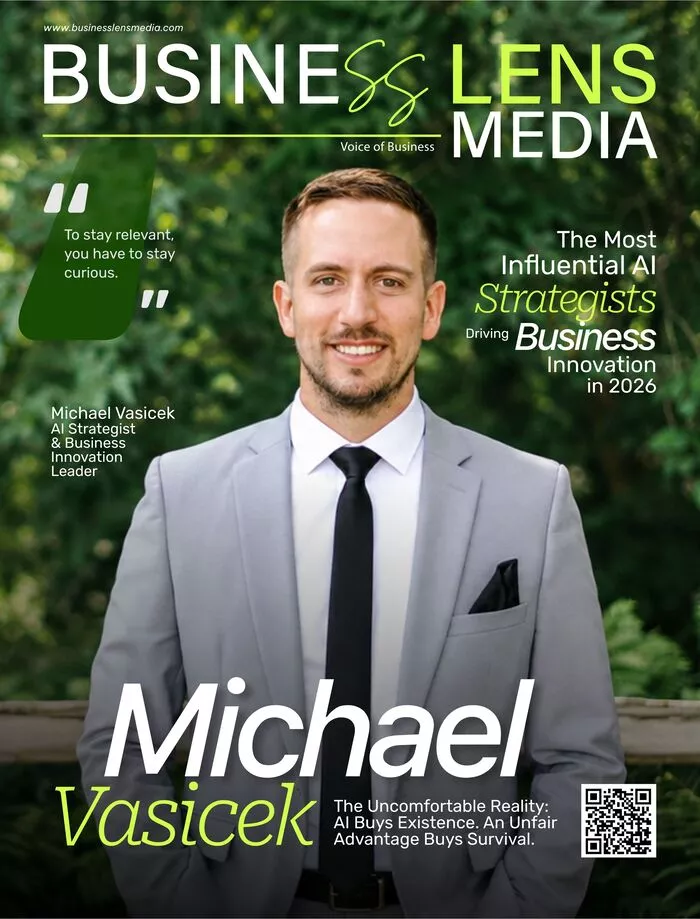
For Michael Vasicek, the significance of artificial intelligence became clear long before AI became a boardroom imperative.
In 2015, Michael relocated for his first major artificial intelligence consulting engagement, working across dozens of countries to help implement a machine learning and predictive analytics solution for a complex procurement environment. The objective was not simply to automate an existing process. The system considered business context and multiple decision factors, including timing, cost, inventory on hand, and supply requirements, to help organizations make more intelligent purchasing decisions.
The experience changed the trajectory of his career.
He had seen technology deliver measurable business value, but he had also witnessed something more important: the potential for AI to influence how organizations made decisions. It became a defining point in his professional life and prompted a deliberate shift toward helping organizations adopt AI in ways that are practical, secure, scalable, and tied to measurable outcomes.
That principle has remained central to Michael’s work as an AI strategist and business transformation leader. Rather than approaching AI as a technology initiative in isolation, he has built his career around a more fundamental question: What business problem are we trying to solve, and where can AI make a meaningful difference, giving you an unfair advantage?
The Business Question Comes First
Michael’s perspective has been shaped by more than two decades in consulting, technology transformation, and executive advisory. Across industries like manufacturing, health, education, utilities and more, he has seen organizations define value in very different ways.
For one business, value may mean revenue growth. For another, it could mean reducing employee turnover or stabilizing the supply chain. Elsewhere, the priority may be reducing risk, strengthening compliance, improving employee skills, or developing products that did not previously exist.
That breadth has influenced the way he approaches transformation.
Instead of beginning with a technology and searching for somewhere to deploy it, Michael starts with the business challenge and the desired outcome. Only then does he consider how AI can be applied.
This distinction becomes increasingly important as organizations face an expanding range of AI capabilities. The availability of powerful tools can create pressure to experiment simply because experimentation is possible. But experimentation without a clear business objective can quickly become fragmented, difficult to scale, and disconnected from enterprise priorities, not to mention costly.
Michael’s approach is therefore less about asking what AI can do in theory and more about determining where it can create meaningful, measurable impact in practice.
His work across industries has also given him a comparative perspective. Patterns that emerge in one sector can reveal opportunities or risks in another. Lessons from one organization can help executives in a completely different environment recognize possibilities they might otherwise overlook.
That cross-industry exposure is one of the assets he brings to executive conversations: the ability to connect seemingly unrelated developments and translate them into business implications.
Bridging the Gaps Inside the Enterprise
One of Michael’s strongest observations about organizational AI adoption concerns the gap between ambition and execution.
Executives may establish broad AI ambitions. Directors and functional leaders are then expected to identify use cases. Employees may begin adopting AI tools independently. Without a mechanism connecting these levels, organizations can end up with multiple isolated experiments rather than a coherent enterprise capability.
Michael has focused on bridging those gaps.
His approach is built around connecting AI strategy across organizational levels so that leadership priorities, operational use cases, and employee adoption reinforce one another. The objective is not simply to increase the number of AI projects underway, but to ensure that those initiatives are connected to measurable business value or meaningful risk reduction.
This requires staying close to two worlds simultaneously.
The first is the rapidly evolving technology landscape, including developments emerging from frontier AI labs. The second is the practical evidence of what is already working across industries. Michael continuously follows both, looking for the intersection between emerging capability and established business need.
That ability to translate technical progress into business opportunity is increasingly important for leaders navigating AI. A new capability may be impressive, but its strategic importance depends on what it enables an organization to do differently, faster, more accurately, or more effectively. Ultimately, the question every leader needs to ask when implementing a solution is; does this give me an unfair advantage?
For Michael, that translation is a central part of the strategist’s role.
Leadership Built on Trust
Technology may be changing rapidly, but Michael’s leadership philosophy rests on principles that are considerably more enduring.
Trust, accountability, and long-term relationships have shaped the way he works with clients, colleagues, executives, and organizations. Early mentors played an important role in establishing that mindset, particularly the belief that the strongest professional relationships are built over decades rather than individual engagements. A line from one of his earliest mentors remains with him to this day, “As you grow in your career, so will others grow in theirs. Developing long-term relationships at every level are what set you up for long term success.”
That philosophy has influenced more than his consulting style. It has shaped how he approaches high-impact decisions and organizational transformation.
Credibility, in his view, comes from consistency, listening, staying connected, and delivering results. Transformation rarely succeeds through a single executive decision or a technology deployment. It requires people with different perspectives to understand the direction, contribute to it, and trust the individuals leading the change.
His leadership approach therefore includes understanding competing viewpoints, developing talent, and drawing on lessons accumulated through global experience.
Working across different organizations, industries, and cultures has reinforced the importance of recognizing that there is rarely a single perspective capable of explaining a complex business problem. The ability to listen, synthesize those perspectives, and act with accountability becomes particularly valuable when leaders are making decisions with significant organizational consequences.
Staying Current by Staying Curious
AI presents a particular challenge for anyone whose expertise depends on remaining current. The technology evolves too quickly for traditional learning models alone to keep pace.
Michael’s response is straightforward: use technology to learn about technology.
Rather than relying on occasional intensive periods of study, he advocates building a continuous flow of information into everyday routines. Podcasts, research papers, blogs, case studies, LinkedIn, X, YouTube, and other digital platforms can all serve a purpose depending on how an individual learns best.
The important point is consistency.
He looks for information about emerging trends, new capabilities, successful applications, and equally important, situations in which technology has fallen short. That last category matters because understanding failure can be as valuable as studying success. It reveals where assumptions break down, where implementation becomes difficult, and where enthusiasm may be running ahead of evidence.
His own approach can involve tools such as Google Alerts, curated social-media feeds, and following key voices in the technology ecosystem.
The commitment does not need to be overwhelming. Ten to 30 minutes a day can create a steady stream of relevant information and help prevent the knowledge gap from becoming too large.
For a strategist working in AI, that discipline is not simply professional development. It is part of the job.
Twenty Years of Variety, One Consistent Purpose
Perhaps the defining feature of Michael’s career is its variety.
More than 20 years in consulting have repeatedly placed him in new industries, organizations, cultures, and business situations. Each engagement has presented a different problem, required new relationships, and demanded a different understanding of what success should look like.
That variety has shaped his thinking about leadership as much as it has shaped his approach to transformation.
Consulting, for Michael, has never been only about applying expertise to a predetermined problem. It has also been a continuous education in how organizations operate, how leaders make decisions, and how people respond to change.
His experience has extended beyond traditional consulting engagements. He has served on nonprofit boards, advised boards on strategic initiatives, and contributed to business planning for new ventures. These experiences have broadened his perspective on governance, strategy, and the relationship between technology decisions and long-term enterprise value.
They have also reinforced what he values most about his work: the opportunity to help organizations and the people within them succeed.
That remains the thread connecting the different chapters of his career.
Looking Beyond the Next AI Use Case
The next stage of Michael’s career is likely to be defined by the same combination of technology, strategy, and governance that has shaped his work to date.
He intends to continue working with organizations facing new and complex challenges while expanding his contribution through board service, including opportunities with private equity-backed and publicly traded companies. His particular interest lies in situations where AI, technology, and business transformation can contribute to meaningful competitive advantage and long-term enterprise value.
That ambition reflects a broader evolution in the role of AI leaders.
As AI becomes more deeply integrated into business, organizations will need leaders who can do more than understand the technology. They will need people capable of connecting technological possibilities with strategy, risk, people, governance, and measurable outcomes.
Michael’s career has increasingly positioned him at that intersection.
His contribution is not defined by predicting which individual AI tool will dominate the next few years. Instead, it lies in helping leaders understand how to think about technological change, how to distinguish meaningful opportunities from noise, and how to turn experimentation into sustainable organizational capability.
The Advantage of Asking Better Questions
For aspiring AI strategists and business leaders, Michael’s advice begins not with a technology certification or a particular tool. It begins with conversation.
He encourages professionals to be intentional about the discussions they seek out. The most useful conversations, he believes, go beyond what is happening today. They explore what is changing, what others are learning, which trends are emerging, and what those shifts could mean for the future.
For people earlier in their careers, that means absorbing as much as possible while actively exchanging ideas with individuals who see the world differently. Expertise, in his view, is not created by collecting facts. It develops through understanding how different insights connect.
For senior leaders, the need for that openness may be even greater. Seniority can create insulation from the realities unfolding elsewhere in an organization or industry. The higher a leader rises, the more deliberate the effort must become to remain connected to colleagues, customers, advisors, and people at every level.
Michael frequently offers his time and strategic insight to both college students and senior executives, pointing out a broader paradox in professional growth: remarkably few people take advantage of open doors. Across the board, fewer than 5 percent, often closer to 1 percent, ever actually initiate the conversation.
Yet he sees that willingness to reach out as a signal in itself.
The individuals who make the effort are demonstrating something more valuable than a desire to meet a particular expert. They are demonstrating curiosity, initiative, and a willingness to keep learning.
Those qualities may ultimately prove more durable than any individual AI capability.
As artificial intelligence continues to reshape how organizations operate and compete, Michael’s career offers a perspective grounded in experience rather than novelty: technology creates possibilities, but leadership determines whether those possibilities become value and unfair advantages.
For him, the future of AI-driven business innovation belongs not simply to those who ask the right questions, but to those who act fast, ship early, and refuse to wait for perfection to move organizations forward.